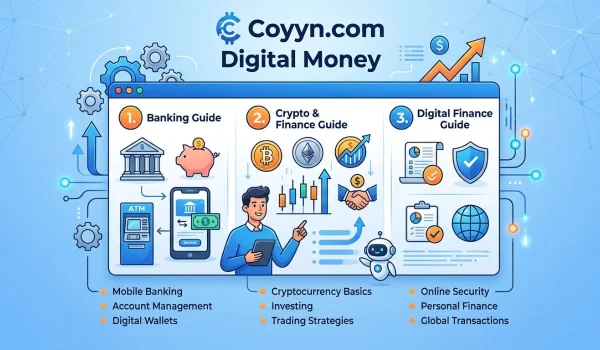
What Is Coyyn.com Digital Money?
Coyyn.com digital money is a search term associated with online information about digital finance, banking, cryptocurrency, digital capital, and the gig economy. Readers searching for it may want to understand what Coyyn.com covers, how digital money works, and whether the information can help them make better financial decisions.
An important distinction is that a website discussing financial technology is not necessarily a bank, payment provider, cryptocurrency exchange, or investment service. Its actual services must be verified before users share personal information, connect a wallet, or send money.
Understanding Coyyn.com and Its Main Purpose
Coyyn.com is associated in the supplied competitor material with topics such as digital banking, cryptocurrency, business finance, investments, and online work. These subjects help readers understand how technology is changing the way people manage money and operate businesses.
However, descriptions in competing articles do not independently establish which financial services Coyyn.com currently provides. Readers should check the website’s current pages, ownership information, terms of service, and disclosures to understand its purpose.
How Coyyn.com Covers Digital Finance and the Modern Economy
Digital finance connects technology with financial activities such as payments, saving, investing, and business transactions. Related topics include:
- Digital wallets and electronic payments.
- Blockchain networks and cryptocurrencies.
- Digital capital and investment concepts.
- Freelancing, remote work, and gig economy payments.
- Business financial tools and cash flow management.
- Financial security, privacy, and consumer protection.
These subjects are increasingly connected. For example, a freelancer may receive income electronically, track expenses with accounting software, and transfer earnings through a digital payment service. Each step involves different providers, fees, and security considerations.
Is Coyyn.com a Financial Platform, an Educational Website, or Both?
The distinction matters because the risks depend on what a website actually does.
An educational website publishes information, guides, analysis, or commentary. A financial platform may provide accounts, payment processing, trading, lending, or custody of digital assets. Some businesses offer both types of services.
Before treating Coyyn.com as a financial service, verify whether it actually provides transactions or primarily publishes educational content. Do not assume that references to digital wallets, smart contracts, or online banking mean those features are available directly through the website.
Who Can Benefit From Coyyn.com Digital Money Content?
Readers exploring digital finance may include:
- Beginners: People learning the difference between digital money, bank deposits, and cryptocurrency.
- Freelancers: Independent workers researching payment methods and income management.
- Small business owners: Entrepreneurs exploring digital payments and financial software.
- Investors: Readers seeking to understand tokenized assets, crypto risks, and diversification.
- Technology enthusiasts: People interested in blockchain, digital identity, and financial innovation.
The most useful financial information explains both the potential benefits and the limitations of a product or technology.
How Coyyn.com Digital Money Works
Digital money refers broadly to monetary value represented and transferred electronically. It includes commercial bank deposits accessed through online banking, electronic payment balances, and certain forms of digital currency.
The way it works depends on the system involved. A bank transfer, a mobile wallet payment, and a cryptocurrency transaction may all happen online, but they use different infrastructures and offer different consumer protections.
Understanding Digital Money and Digital Transactions
Digital money allows people and businesses to make payments without exchanging physical cash. A typical electronic transaction involves a sender, a payment instruction, a system that verifies the transaction, and a recipient.
For example, when a customer pays a shop through a banking app, the bank authenticates the instruction and updates the relevant account records. Card payments may involve a merchant, payment processor, card network, and issuing bank.
Cryptocurrency transactions work differently. A blockchain network records eligible transactions according to its protocol, and network participants validate them. The process, fees, confirmation times, and reversal options depend on the specific network and service.
The Role of Digital Wallets and Online Payment Systems
A digital wallet helps users store payment credentials, manage supported balances, or authorize transactions. Not every wallet holds money directly.
Common types include:
- Banking wallets: Interfaces connected to bank accounts.
- Mobile payment wallets: Services that store payment credentials or support eligible transactions.
- Prepaid wallets: Products that may hold a balance under specific terms.
- Cryptocurrency wallets: Tools that manage the keys used to access blockchain assets.
- Business payment accounts: Services designed to accept customer payments and manage payouts.
Before choosing a wallet, check supported currencies, fees, withdrawal rules, account eligibility, dispute procedures, and security controls. For cryptocurrency wallets, understand who controls the private keys.
How Digital Money Moves Between Individuals and Businesses
A digital payment generally follows a series of steps:
- The sender enters payment details and authorizes the transaction.
- The service checks the instruction and applies its security procedures.
- The relevant payment network or ledger processes the transaction.
- The recipient receives a credit or transaction confirmation.
- The parties can review the transaction record.
This sequence varies by payment method. Some payments settle quickly, while others require additional processing. International transfers may also involve intermediary institutions, currency conversion, compliance checks, and extra fees.
A payment confirmation does not always mean the recipient can immediately withdraw the money. Users should distinguish between authorization, processing, and final settlement.
Digital Money vs. Electronic Bank Deposits vs. Cryptocurrency
| Feature | Electronic bank deposits | Digital payment wallets | Cryptocurrencies |
| Representation | Bank account balance | Credentials or a balance, depending on the service | Digital assets recorded on a blockchain |
| Main purpose | Saving and making payments | Convenient payments and transfers | Transfers, applications, or investment, depending on the asset |
| Value stability | Depends on the currency and bank arrangement | Depends on the underlying balance or asset | Varies by cryptocurrency |
| Transaction records | Bank records | Provider records and, where relevant, underlying network records | Blockchain records for on-chain transactions |
| Reversals and disputes | Depend on payment type and applicable rules | Depend on provider terms and payment method | Many confirmed on-chain transfers cannot be reversed by the network |
| Protection | Depends on the institution and jurisdiction | Depends on the provider and underlying funds | Depends on custody, asset, and applicable law |
These categories can overlap. A wallet may simply provide access to a bank account, while a cryptocurrency wallet may never hold traditional currency at all.
What Topics Does Coyyn.com Cover?
The supplied competitor headings associate Coyyn.com with several areas of digital finance and business. These categories provide a useful framework for exploring its content, although current availability and coverage should be confirmed directly on the website.
Coyyn.com Digital Banking and Financial Technology
This topic covers online banking, mobile payments, financial software, digital transactions, and the technology behind modern financial services. Readers can use these concepts to compare convenience, costs, and security.
Coyyn.com Digital Capital and Investment Concepts
Digital capital can refer to financial resources and assets managed or accessed through digital systems. Related subjects include venture capital, private equity, digital assets, investment risk, and tokenization.
These topics require careful distinctions because an educational article about an investment does not establish that a website offers that investment.
Coyyn.com Cryptocurrency, Stablecoins, and Blockchain
This category concerns blockchain networks, digital assets, decentralized finance, and stablecoins. Readers should understand the difference between a cryptocurrency’s market value, the technology supporting it, and the legal rights attached to a particular asset.
Coyyn.com Business, Entrepreneurship, and Digital Tools
Business-related topics may include payment processing, online business operations, accounting software, digital marketing, and financial management. The goal is to help entrepreneurs understand the tools that support day-to-day operations.
Coyyn.com Gig Economy and Freelance Work
The gig economy includes independent contractors, freelancers, temporary assignments, and platform-based work. Digital payments make it easier to receive earnings, but workers still need to consider taxes, platform fees, and irregular income.
Coyyn.com Rare Coins and Alternative Assets
Rare coins and collectibles belong to the broader alternative-asset category. Their value depends on factors such as authenticity, condition, scarcity, demand, and market liquidity. They differ significantly from digital currencies and tokenized assets.
Coyyn.com Personal Finance, Budgeting, and Saving
Personal finance topics cover spending plans, emergency funds, savings, payment fees, and financial goals. Digital tools can simplify these activities, but users still need reliable records and sensible spending habits.
Coyyn.com Digital Banking and Online Financial Services
Digital banking allows customers to access financial services through websites and mobile applications instead of relying exclusively on physical branches. Services may include balance checks, transfers, bill payments, transaction histories, and account management.
Coyyn.com’s published description discusses digital banking as an educational topic. Readers should distinguish this coverage from proof that Coyyn itself offers bank accounts or processes payments.
Understanding Digital Banking and Its Core Features
Common digital banking features include:
- Online access to account balances and statements.
- Domestic transfers and eligible international payments.
- Bill payments and scheduled transactions.
- Spending notifications and transaction searches.
- Digital account opening, where supported.
- Security controls such as multifactor authentication.
Available features depend on the bank, country, account type, and service provider. Some institutions also impose transaction limits or charge fees for particular services.
Digital Banking vs. Traditional Banking
Traditional banking often combines branch-based service with online access. Digital-first banking emphasizes electronic account management and remote customer support.
Digital banking can save time and simplify routine transactions. Traditional branches may remain useful for complex disputes, cash services, or customers who prefer face-to-face assistance.
Neither model is automatically safer or cheaper. Compare account fees, deposit protection, customer support, fraud procedures, accessibility, and the institution’s regulatory status.
Mobile Banking, Online Payments, and Account Access
Mobile banking applications allow users to review transactions, transfer funds, and receive account alerts. Online payment services may also let customers pay merchants or send money to other users.
For safer access, use unique passwords, enable multifactor authentication, update your devices, and avoid logging in through unexpected links. Confirm recipient details before authorizing transfers, particularly when sending money internationally.
How to Verify Whether Coyyn.com Offers Actual Banking Services
Do not assume Coyyn.com provides a banking app, deposit account, or payment service simply because its content discusses digital banking.
To verify a specific service, check:
- Whether the website explicitly offers account registration or transactions.
- The legal name of the company responsible for the service.
- Whether a bank or licensed payment provider supports the product.
- Which regulator oversees the relevant institution, if applicable.
- The terms governing fees, withdrawals, disputes, and customer funds.
If the website only publishes articles, you do not need to create a financial account to read that content. Avoid submitting identity documents or payment details unless there is a clear, independently verifiable reason.
Benefits and Limitations of Digital Financial Services
Digital financial services can offer convenience, rapid access, transaction records, and tools for managing everyday money. They may also help people in remote areas access services unavailable nearby.
However, users can encounter phishing attacks, account restrictions, outages, privacy concerns, and unexpected charges. Some providers offer limited dispute assistance, while cryptocurrency transactions may not have the same recovery options as conventional payments.
The practical choice is the service that meets your needs while providing transparent fees, appropriate safeguards, and accessible support.
Coyyn.com Digital Money and Cryptocurrency
Cryptocurrency is one part of the broader digital finance landscape. It uses cryptographic techniques and, in many cases, blockchain or other distributed ledger technology to record and verify transactions.
Coyyn.com’s cryptocurrency-related content can serve as a starting point for understanding this subject. Readers should conduct separate research before buying, trading, or transferring digital assets.
How Cryptocurrency Differs From Traditional Digital Money
Traditional digital money usually represents a claim or balance maintained by a bank or payment provider. Cryptocurrency generally operates through a digital asset network whose rules determine how transactions are recorded and validated.
The difference affects control, risk, and consumer protection. A bank may be able to investigate a disputed transfer or freeze an account under applicable rules. A decentralized blockchain network generally cannot simply cancel a confirmed transaction because the sender made a mistake.
Cryptocurrency is also not necessarily a substitute for cash. Its acceptance, price stability, and legal treatment vary by asset and jurisdiction.
Bitcoin, Ethereum, and Other Digital Assets
Bitcoin is a cryptocurrency that operates on its own blockchain. Ethereum supports a blockchain network that can run smart contracts and decentralized applications, as well as its native asset, ether.
Other digital assets may serve different purposes:
- Payment or transfer functions.
- Access to a digital service.
- Governance within a blockchain project.
- Representation of certain rights or interests.
- Stable-value objectives linked to reference assets.
A token’s name or marketing description does not establish its value, utility, or legal rights. Review its documentation, issuance model, liquidity, and risks before considering a purchase.
Stablecoins and Their Role in Digital Payments
Stablecoins are digital tokens designed to maintain a relatively stable value against a reference asset, often a currency such as the US dollar. Their mechanisms differ: some rely on reserve assets, while others use different collateral or stabilization arrangements.
A stablecoin’s target value is not a guarantee. Its market price can deviate from the intended peg, and users may face redemption restrictions, issuer risk, liquidity problems, or regulatory changes.
Before using one for payments, check how reserves are managed, who can redeem the token, which networks support it, and what fees apply.
Blockchain Technology and Decentralized Finance (DeFi)
A blockchain is a type of distributed ledger that records transactions in an ordered structure. Network rules and validation mechanisms help participants agree on the ledger’s state.
Decentralized finance, or DeFi, uses blockchain-based applications for activities such as exchanging assets, borrowing, lending, and supplying liquidity. Some applications rely on smart contracts to execute predefined instructions.
DeFi can reduce reliance on certain intermediaries, but it introduces technical and financial risks. Vulnerable code, manipulated prices, malicious projects, and sudden liquidity changes can cause losses.
Smart Contracts and Peer-to-Peer Transactions
A smart contract is software deployed on a blockchain that executes according to programmed conditions. It may automate a payment, exchange, or other transaction when specified requirements are met.
For example, a contract could exchange two supported digital assets when the transaction meets its programmed rules. This automation does not guarantee that the contract is secure or that the transaction is legally enforceable in every jurisdiction.
Peer-to-peer transactions allow participants to exchange value directly or through a service that connects them. Users should verify wallet addresses, network compatibility, fees, and the identity of counterparties where relevant.
Cryptocurrency Volatility, Liquidity, and Investment Risks
Cryptocurrency prices can change sharply, sometimes within short periods. A digital asset may also become difficult to sell if trading activity declines or a platform suspends withdrawals.
Important risks include:
- Market risk: The asset’s price may fall substantially.
- Liquidity risk: Buyers may be unavailable at the desired price.
- Custody risk: A wallet provider or exchange may lose access to assets.
- Technical risk: Software vulnerabilities or network failures may affect transactions.
- Fraud risk: Projects may misrepresent their products or disappear with customer funds.
- Regulatory risk: Laws and restrictions may change.
- Concentration risk: Too much exposure to one asset can magnify losses.
The US Securities and Exchange Commission’s Investor.gov guidance on crypto asset risks explains why investors should examine volatility, custody arrangements, and the protections available before committing funds.
Never treat projected returns, online testimonials, or claims of guaranteed profits as proof that an investment is safe.
Cryptocurrency Self-Custody vs. Exchange-Based Storage
Self-custody means you control the private keys needed to authorize transactions. Exchange-based or third-party custody means another provider controls those keys on your behalf.
| Consideration | Self-custody | Third-party custody |
| Control | You manage the private keys | The provider manages access to the keys |
| Responsibility | You handle backups and security | You depend partly on the provider’s controls |
| Access recovery | Losing recovery information can cause permanent loss | Recovery depends on provider policies and account access |
| Main risks | Lost keys, theft, device damage, user mistakes | Provider failure, account restrictions, breaches, withdrawal suspensions |
| Convenience | Depends on wallet setup and user experience | May offer simpler account recovery and trading |
A self-custody wallet does not store cryptocurrency in the same way a physical wallet holds cash. It manages the keys that allow the owner to control assets recorded on the blockchain.
Never share a seed phrase or private key with someone claiming to provide support. Verify transaction details before signing wallet requests, and research any custodian’s legal status and withdrawal terms.
Digital Money Security, Privacy, and Scam Prevention
Security is essential whenever money, personal information, or digital assets move online. A website may look professional and still be unsafe, so design quality and technical encryption alone are not sufficient evidence of trustworthiness.
How Digital Wallet Security Works
Digital wallets use different security mechanisms depending on the provider and technology. These may include passwords, device authentication, encryption, transaction confirmations, and fraud monitoring.
For cryptocurrency wallets, private keys authorize transactions. A provider may manage those keys, or users may retain control themselves.
Use a wallet that clearly explains its security model. Check whether it supports multifactor authentication, recovery options, transaction alerts, and withdrawal controls. Keep devices updated and avoid installing wallet software from unverified sources.
Private Keys, Seed Phrases, and Multi-Factor Authentication
A private key authorizes access to a cryptocurrency asset. A seed phrase can restore access to a wallet, depending on its design.
Protect these credentials carefully:
- Never disclose a seed phrase to a stranger or support agent.
- Keep recovery information in a secure location.
- Avoid storing unencrypted recovery phrases in cloud notes or ordinary messages.
- Use multifactor authentication on accounts that support it.
- Consider a hardware wallet when the value and circumstances justify it.
Multifactor authentication adds a second verification step, but it cannot eliminate every risk. Attackers may still exploit phishing, compromised devices, or fraudulent transaction approvals.
How to Identify Fake Financial Websites and Crypto Scams
Warning signs include unrealistic returns, pressure to act immediately, unclear company ownership, fake endorsements, and requests to pay unexpected fees before withdrawing money.
Be especially cautious if a website or person:
- Promises guaranteed investment profits.
- Requests payment in cryptocurrency to unlock an account.
- Claims you must pay a tax or verification charge to release supposed earnings.
- Asks for your private key or seed phrase.
- Uses a lookalike domain or an impersonated brand.
- Refuses to explain how a product works or who operates it.
The US Federal Trade Commission’s guide to cryptocurrency scams explains common fraud patterns and why scammers often pressure victims to send irreversible payments.
Phishing, Identity Theft, and Unauthorized Transactions
Phishing messages imitate trusted companies to persuade people to reveal passwords, payment details, or verification codes. Identity theft may follow when criminals obtain personal information through fraudulent forms or compromised accounts.
Reduce your exposure by typing website addresses directly, checking the complete domain, and avoiding unexpected attachments. Never approve a login or transaction you did not initiate.
Review transaction notifications regularly. If you notice unauthorized activity, contact the relevant bank, wallet provider, or platform immediately and secure your affected accounts.
Steps to Take After a Suspected Digital Money Scam
Act quickly if you have sent money or disclosed sensitive information.
- Contact your bank, card issuer, or payment provider and ask whether the transaction can be stopped or disputed.
- Change compromised passwords from a trusted device and revoke suspicious sessions.
- Secure affected email, banking, and cryptocurrency accounts.
- Preserve transaction IDs, wallet addresses, messages, receipts, and screenshots.
- Report the incident to the relevant consumer protection agency or law enforcement authority.
- If cryptocurrency was involved, contact the exchange or wallet service involved in the transfer, understanding that recovery may be difficult.
Be wary of recovery agents who demand upfront fees or promise guaranteed refunds. Fraud victims are often targeted again by people claiming they can recover stolen funds.
How to Verify a Website’s Ownership, Contact Details, and Security Claims
Start with the website’s About, Contact, Privacy Policy, Terms of Service, and financial disclosures. Check whether the business name and contact details are consistent across its published materials.
HTTPS encrypts information sent between your browser and a website, but it does not prove that the operator is honest or financially regulated.
For any service that handles money, independently check the relevant company register or regulator’s database. Look for the exact legal entity, authorized activities, and any restrictions. Do not rely solely on badges, screenshots, or registration numbers displayed by the website itself.
Coyyn.com Digital Capital and Investment Concepts
Digital capital describes financial resources, digital assets, and investment opportunities connected with technology-driven markets. The term can refer to different things depending on the context, so readers should establish exactly what an article or provider means by it.
Coyyn.com’s coverage of digital capital and investments should be understood as financial information unless a specific, verifiable service states otherwise.
What Is Digital Capital?
Digital capital can refer to money, investment resources, or digital assets used to create economic value. Examples include funds managed through digital financial services, investments in technology companies, and certain blockchain-based assets.
The term does not describe one standardized financial product. A digital bank balance, a stake in a technology startup, and a cryptocurrency token have different legal characteristics and risks.
Digital Capital vs. Traditional Capital
Traditional capital includes financial resources used to fund business operations, equipment, property, and expansion. Digital capital can involve similar resources managed or transferred through digital systems.
For example, a startup may use conventional equity financing while accepting customer payments through digital channels. The financing is not necessarily a digital asset simply because the business operates online.
The distinction is useful when evaluating financial opportunities. Ask whether an offering represents ownership, debt, a payment balance, a contractual claim, or a digital token. Those differences affect the rights and risks involved.
Venture Capital, Private Equity, and Digital Investments
Venture capital typically finances young companies with growth potential in exchange for an ownership interest. Private equity generally involves investments in private companies, although strategies and structures vary.
Digital investments may include technology businesses, digital infrastructure, software companies, or blockchain-related ventures.
These investments can offer opportunities for growth, but they may also involve limited liquidity, uncertain valuations, long holding periods, and substantial risk. Investors should review the business model, financial information, ownership structure, fees, and exit conditions before committing capital.
Real-World Asset Tokenization: Benefits and Limitations
Real-world asset tokenization involves representing certain rights associated with physical or traditional financial assets through digital tokens. Potential examples include property interests, commodities, debt instruments, or fund interests.
Tokenization may make some transactions easier to track and may support fractional ownership where the legal structure permits it. However, a token does not automatically grant direct ownership of the underlying asset.
Before considering a tokenized investment, establish:
- What legal rights the token provides.
- Who owns and safeguards the underlying asset.
- Whether independent records or audits are available.
- How transfers, redemptions, and distributions work.
- Which laws govern the offering.
- Whether a market exists for selling the token.
The quality of the legal arrangements matters as much as the technology. A token can function correctly on a blockchain while the underlying business or ownership claim remains disputed.
How to Evaluate Digital Assets Before Investing
Use a consistent research process rather than relying on price predictions or social media discussions.
First, identify the asset’s purpose and how it is expected to generate value. Next, examine its issuer, ownership structure, financial disclosures, and available trading markets.
Then assess the following factors:
- Transparency: Can you verify the project’s claims?
- Liquidity: Can you sell the asset without a large price concession?
- Costs: What are the trading, custody, withdrawal, and management fees?
- Security: Who controls the assets, and what happens after a breach?
- Legal rights: What claim do you actually own?
- Risk tolerance: Could you absorb a significant or total loss?
Avoid making an investment solely because an article describes it as innovative, popular, or potentially profitable.
Portfolio Diversification, Risk Tolerance, and Investment Time Horizons
Diversification means spreading investments across different assets or categories rather than relying heavily on one holding. It can reduce concentration risk, although it cannot eliminate market losses.
Risk tolerance concerns how much uncertainty and loss you can financially and emotionally withstand. Your investment time horizon is the period before you expect to need the money.
For example, money needed for rent or an emergency fund generally should not be exposed to the same level of market risk as funds reserved for a distant financial goal.
A sensible plan starts with essential expenses, high-interest debt, emergency savings, and an understanding of the risks of each investment. The appropriate balance depends on individual circumstances.
Why Educational Content Should Not Replace Professional Financial Advice
Financial articles can explain concepts and help readers prepare questions, but they may not account for a person’s income, debts, tax obligations, residency, or financial goals.
Treat educational content as a starting point. For significant decisions involving investments, taxes, or regulated financial products, consult a suitably qualified professional familiar with the applicable jurisdiction.
Coyyn.com and the Gig Economy
The gig economy includes work performed through short-term assignments, freelance contracts, and digital platforms. It allows people to offer services to multiple clients, but income and working conditions can vary considerably.
Digital finance supports this model by making invoicing, receiving payments, and tracking earnings easier.
What Is the Gig Economy and How Does It Work?
In the gig economy, workers often earn money by completing specific projects, shifts, or tasks rather than working exclusively under a traditional long-term employment arrangement.
Examples include freelance writing, graphic design, programming, tutoring, delivery work, and ride-hailing. Some workers choose this model for flexibility, while others use it to supplement their primary income.
The arrangement matters. Independent contractors and employees may have different rights, benefits, tax responsibilities, and insurance arrangements depending on local law.
Freelancing, Remote Work, and Digital Entrepreneurship
Freelancing allows people to sell their skills to clients without necessarily joining a single employer. Remote work describes where work takes place, so a remote worker may still be a regular employee.
Digital entrepreneurship involves building a business using online tools, platforms, or distribution channels. Examples include selling digital products, providing consulting services, or operating an online store.
Success depends on more than finding clients. Workers must also manage pricing, contracts, deadlines, customer relationships, expenses, and cash flow.
AI’s Impact on Freelancers and Independent Workers
Artificial intelligence can help freelancers research topics, organize information, prepare drafts, analyze data, and automate repetitive tasks. It may also increase competition by making some services faster or cheaper to produce.
Workers can respond by developing specialized expertise, improving quality control, protecting client information, and learning to use AI tools responsibly.
AI-generated work still requires human review. Errors, confidentiality concerns, copyright questions, and client-specific requirements can create problems if automated output is used without checking it.
Top Gig Economy Platforms for Finding Online Work
Different platforms serve different skills and working arrangements. Examples include:
- Upwork for a broad range of freelance services.
- Fiverr for packaged services and project-based work.
- Freelancer.com for freelance projects and competitive bidding.
- Toptal for selected professional talent and specialized work.
- FlexJobs for curated remote and flexible job listings.
- PeoplePerHour for freelance services and project work.
Platform availability, eligibility, fees, and payment methods vary by country and may change. Verify the current terms directly before joining.
Compare the platform’s client base, dispute procedures, withdrawal options, service charges, and competition. A platform that suits a designer may not be the best fit for a delivery driver or a full-time remote employee.
Digital Payments for Freelancers and Gig Workers
Freelancers may receive payment through bank transfers, payment processors, digital wallets, or approved platform payout systems.
Before accepting a method, confirm its supported countries, withdrawal fees, conversion rates, settlement time, and documentation requirements. International workers should also consider currency fluctuations and intermediary bank charges.
Use written contracts that establish the payment amount, currency, milestones, delivery conditions, and due date. Keep invoices and payment confirmations for accounting and tax purposes.
Gig Economy vs. Traditional Employment
| Factor | Gig work | Traditional employment |
| Schedule | Often flexible, depending on the contract | Usually follows agreed working hours |
| Income | May fluctuate with demand | Often more predictable |
| Benefits | May need to be arranged independently | May include employer-provided benefits |
| Taxes | Workers may have additional filing and payment duties | Employers commonly handle some payroll obligations |
| Client or employer control | Varies by contract and actual working relationship | Usually follows the employment arrangement |
| Career development | Often depends on personal networking and projects | May include structured training and promotion |
Neither arrangement is universally better. Gig work may offer flexibility, while traditional employment may provide more predictable income and benefits. Actual rights depend on local law and the working relationship, not simply the label used in a contract.
Taxes, Recordkeeping, and Financial Planning for Gig Workers
Gig workers should keep records of income, invoices, platform fees, business expenses, and relevant receipts. Separate business and personal transactions where practical.
Tax obligations vary by country, residency, employment status, and type of income. Some workers may need to make estimated tax payments or register for specific taxes, while others may have different requirements.
A practical financial routine includes:
- Recording income when received and tracking outstanding invoices.
- Saving documentation for potentially deductible business expenses.
- Setting aside money for expected tax obligations.
- Maintaining an emergency reserve for slow periods.
- Reviewing earnings after platform fees and other work-related costs.
- Seeking local tax advice when the rules are unclear.
Do not assume that a platform has paid your taxes simply because it processes your earnings.
Managing Irregular Income, Savings, and Emergency Funds
Variable income makes budgeting more difficult because earnings may change from month to month.
Estimate essential expenses first, then review income across several months to understand your typical earning range. Build a reserve gradually during stronger periods, and avoid committing to recurring expenses based on an unusually profitable month.
A separate account or clearly tracked savings category can help keep tax money and emergency funds available when needed. Review your budget regularly and adjust it when client demand or personal circumstances change.
Coyyn.com Digital Tools for Businesses and Entrepreneurs
Digital tools help businesses receive payments, organize financial records, manage customer relationships, and monitor performance. The right combination depends on business size, transaction volume, operating countries, and regulatory obligations.
Digital Payment Solutions for Small Businesses
Small businesses can accept payments through card processors, online checkout services, bank transfers, and other supported methods.
Before choosing a provider, compare transaction fees, settlement times, chargeback procedures, accepted payment methods, and integration options. International businesses should also check currency conversion costs and country restrictions.
A payment service should fit the business’s actual needs rather than merely advertise the largest feature set.
Financial Technology for Business Operations
Financial technology, often called fintech, includes software and services used to support payments, lending, financial records, and other money-related activities.
A business might use a payment processor for sales, accounting software for bookkeeping, and a bank account for operating expenses. Integration can reduce duplicate data entry, but errors may still occur when systems use different categories or reporting periods.
Businesses should test integrations, restrict access to sensitive records, and maintain reliable backups.
Digital Invoicing, Expense Tracking, and Cash Flow Management
Digital invoicing tools help businesses prepare bills, monitor payment status, and send reminders. Expense tracking organizes purchases and other costs, while cash flow management compares money entering the business with money leaving it.
For example, a profitable project may still create a cash shortage if the client pays several weeks after the business must pay its suppliers.
Regularly review unpaid invoices, upcoming bills, available cash, and expected revenue. Accurate records make it easier to identify late payments and plan for upcoming obligations.
Online Business Tools for Freelancers and Startups
Common tools include accounting software, invoicing systems, project management applications, customer relationship management platforms, and secure document storage.
Choose tools based on a clear business requirement. Check subscription costs, data export options, access permissions, integrations, and what happens to your records if you cancel the service.
Avoid paying for overlapping tools unless the extra features provide measurable value.
How to Evaluate a Digital Finance Tool Before Using It
Before adopting a financial tool, consider:
- Whether the provider clearly identifies the responsible legal entity.
- Which countries, currencies, and business types it supports.
- Whether pricing and additional fees are transparent.
- How it protects and stores customer data.
- What support is available during disputes or outages.
- Whether it integrates with your existing accounting systems.
- How easily you can export records or close your account.
A free trial is useful for testing functionality, but it does not establish that a service is secure, compliant, or suitable for sensitive financial activity.
Comparing Transaction Fees, Features, Accessibility, and Support
Do not compare services using headline transaction rates alone. A provider may charge extra for currency conversion, withdrawals, chargebacks, monthly subscriptions, or international transfers.
Evaluate the total cost using your expected transaction volume and average payment size. Also consider whether customers can use their preferred payment methods and whether the provider offers support during your business hours.
For a small business, reliable settlement and clear dispute procedures may matter more than a minor difference in advertised fees.
Digital Money for Everyday Personal Finance
Digital financial tools can make everyday money management easier, but convenience does not replace budgeting or careful decision-making. Users benefit most when they understand where their money goes, how services charge fees, and which protections apply.
How to Create a Digital Budget and Track Spending
Start by recording monthly income and essential expenses, including housing, food, utilities, transportation, debt payments, and savings.
Categorize discretionary spending separately so you can identify areas to adjust. Banking applications and budgeting software can help, but check whether transactions are categorized correctly.
Review your budget at least monthly. If your income changes, prioritize essential costs and adjust optional spending before taking on new recurring commitments.
Digital Payments for Bills, Shopping, and Transfers
Digital payments can simplify recurring bills, online purchases, and transfers between people. They also create transaction records that help with budgeting and dispute resolution.
Before confirming a payment, verify the recipient, amount, currency, and any processing fee. For unfamiliar merchants, review refund policies and avoid payment methods that provide less recourse than you need.
Convenience should not override verification, particularly when someone asks you to change established payment details at short notice.
Building Savings Habits With Financial Technology
Automatic transfers can help users save consistently when their income and expenses allow it. Spending alerts can also highlight unexpected charges or changes in financial habits.
Set a realistic savings target and build an emergency fund gradually. If your income is irregular, choose an amount that remains manageable during slower months rather than setting an inflexible target based on your best month.
Keep emergency savings accessible and consider the safety and terms of the institution holding them.
Understanding Transaction Fees, Exchange Rates, and Transfer Limits
Digital financial services may charge flat fees, percentage-based fees, currency conversion margins, or withdrawal charges.
For example, a transfer advertised as having no sending fee may still involve an unfavorable exchange rate. Compare the final amount the recipient will receive rather than looking at the headline fee alone.
Also check daily transfer limits, processing times, and additional requirements for larger payments. These conditions can affect whether a service suits your needs.
International Payments and Cross-Border Transfers
International transfers may involve a sending provider, intermediary institutions, a receiving provider, and currency conversion. Each participant may affect the final cost or processing time.
Before sending money, verify the recipient’s details and compare the total cost, exchange rate, delivery estimate, and cancellation options. Check whether the recipient can withdraw the funds in their country.
Businesses and freelancers should also retain records showing the payment amount, currency, fees, and purpose of the transfer.
How to Choose a Digital Wallet That Fits Your Needs
Choose a wallet based on how you intend to use it. A person making everyday purchases may need a different service from someone receiving international freelance payments or managing cryptocurrency.
Compare supported currencies, countries, payment methods, fees, account limits, customer support, security features, and recovery procedures. If the wallet holds cryptocurrency, determine whether you or the provider controls the private keys.
Do not transfer a large balance simply to test a new wallet. Start only after verifying the provider and understanding how deposits, withdrawals, and account closure work.
Coyyn.com Rare Coins and Alternative Assets
Rare coins and other collectibles attract buyers who value their historical significance, scarcity, condition, or potential resale value. They differ from conventional financial investments because their prices depend heavily on specialist markets and individual buyer demand.
Although Coyyn.com’s competitor headings mention rare coins, readers should verify whether the website provides educational information, listings, or actual buying and selling services.
What Are Rare Coins and Collectible Assets?
Rare coins are coins valued for characteristics beyond their face value. These may include limited mintage, historical significance, unusual minting errors, precious-metal content, and condition.
Other collectible assets include certain works of art, vintage items, and historical objects. Their markets may be less transparent than those for publicly traded securities, and finding a buyer can take time.
A collectible’s age alone does not make it valuable. Rarity, authenticity, condition, demand, and comparable sales all matter.
How Coin Grading, Authenticity, and Market Demand Affect Value
Coin grading evaluates a coin’s condition using established criteria. Higher grades can command higher prices for some coins, but the relationship depends on the specific issue and market.
Before purchasing a rare coin, investigate:
- Its date, mint mark, and identifying features.
- Whether its authenticity has been independently assessed.
- Its grade and any damage or alterations.
- Recent sales of comparable coins.
- The seller’s reputation and return policy.
- Insurance, storage, and resale costs.
A seller’s asking price is not proof of market value. Recent completed sales are generally more informative than unsold listings, although differences in condition and provenance still matter.
Rare Coins vs. Cryptocurrency and Tokenized Assets
Rare coins are physical objects whose value depends partly on authenticity, condition, and collector demand. Cryptocurrencies are digital assets whose values may depend on market demand, network utility, scarcity mechanisms, or other factors.
Tokenized assets are different again. Their value and legal rights depend on the underlying asset, the token’s structure, and the enforceability of the associated arrangements.
All three categories can involve volatility and liquidity risks. However, their valuation methods, storage needs, legal treatment, and transaction processes differ substantially.
Risks of Collectibles as Alternative Investments
Collectibles may be difficult to price, store, insure, and sell. Buyers may also face counterfeits, undisclosed damage, high dealer margins, and limited independent market information.
A coin can be historically important without appreciating in price. Even when its market value rises, selling it may involve auction fees, dealer commissions, and a lengthy search for a buyer.
Treat collectibles as specialized purchases rather than guaranteed investments. Avoid committing money needed for essential expenses.
How to Research Rare Coins Before Making a Purchase
Begin with a clear description of the coin and research its recognized characteristics, grading standards, and historical context. Compare completed sales for similar examples, not just coins with the same date.
For higher-value purchases, consider independent authentication and grading. Request documentation, inspect the return policy, and confirm the seller’s identity before paying.
If a coin is advertised as exceptionally rare or guaranteed to rise in value, seek independent evidence rather than relying on promotional claims.
Is Coyyn.com Legitimate and Safe to Use?
Coyyn.com presents itself as an informational resource covering digital capital, finance, cryptocurrency, business, and the gig economy. Its published About Coyyn page describes these subject areas.
That establishes how the website describes its purpose, but it does not independently verify every article, claim, or external service mentioned in its content. Legitimacy, editorial reliability, and financial-service authorization are separate questions.
How to Assess Coyyn.com’s Transparency and Credibility
Assess the website by examining its ownership disclosures, editorial information, contact details, privacy policy, and terms of use.
Look for articles that explain their reasoning, distinguish facts from opinions, and identify limitations. For financial topics, check whether claims are supported by primary documents or reliable sources.
A polished website and a broad range of articles are not sufficient evidence that every statement is accurate.
Checking Website Ownership, Editorial Standards, and Contact Information
Review the site’s About and Contact pages to understand who operates it and how readers can raise concerns. Check whether the information is consistent and whether the site explains how it handles corrections or updates.
When an article discusses a particular financial product, look for its publication date and links to relevant official documentation. Older content may not reflect current fees, laws, or product features.
If the author or operator is not clearly identified, treat that as a reason for further investigation rather than automatic proof of misconduct.
How to Verify Financial Licenses and Regulatory Claims
If a website claims to provide banking, investment, lending, or payment services, verify the legal entity and its authorization with the relevant regulator.
The appropriate authority depends on the service and jurisdiction. A company authorized for one activity may not be permitted to offer every type of financial product.
Search official registers independently and compare the registered name, domain, contact details, and authorized activities. Do not rely exclusively on a license number or regulatory logo displayed on a website.
Does Coyyn.com Handle Money or Primarily Publish Financial Information?
Coyyn.com’s published description and contact-page disclaimer characterize it as an informational resource rather than a financial advisory firm. Readers should therefore avoid assuming that it offers banking accounts, payment processing, or cryptocurrency custody.
For any specific product mentioned on the website, identify the actual provider and review its terms directly. If a third-party service is involved, assess that provider separately.
This distinction is important because reading about a financial service does not create an account with it, and a website’s educational coverage does not establish that it can safeguard customer funds.
Warning Signs to Check Before Sharing Personal or Financial Data
Be cautious if a site or associated representative asks for unnecessary identity documents, bank passwords, seed phrases, or upfront payments without a clear explanation.
Other warning signs include misleading claims about guaranteed returns, unclear ownership, pressure to act immediately, and withdrawal conditions that appear only after money has been deposited.
Never provide sensitive information merely because a website discusses finance or uses familiar financial terminology.
What Users Should Verify Before Registering, Paying, or Investing
Before taking action, confirm the following:
- The exact service being offered and the responsible legal entity.
- The provider’s authorization, where required.
- The complete fee schedule and withdrawal rules.
- The privacy policy and information-sharing practices.
- The process for complaints, disputes, and account closure.
- The risks and legal rights associated with any financial product.
If you cannot independently verify essential details, do not send money or disclose sensitive information.
Digital Finance Regulations and Consumer Protection
Digital finance operates under different legal frameworks depending on the country, service, and financial product. Rules for bank deposits, payment services, securities, and cryptocurrency are not interchangeable.
A website’s general discussion of financial regulation does not establish that the website or any service it mentions is licensed.
How Financial Regulations Differ Across Countries
Countries regulate financial services through different laws and institutions. Requirements may depend on where the provider is established, where its customers live, and what activity it performs.
For example, a payment service may require authorization in certain markets, while an investment offering may be subject to separate securities rules.
Before using a cross-border service, check which law applies, how disputes are handled, and whether the provider is permitted to serve residents of your country.
Cryptocurrency and Digital Payment Compliance
Cryptocurrency and digital payment rules can cover licensing, customer verification, financial crime prevention, disclosures, reporting, and consumer protection.
The requirements vary by asset and activity. A business that processes payments may face different obligations from a platform that trades digital assets or provides custody.
Do not assume that a cryptocurrency project is lawful everywhere because it operates online. Verify local requirements and any restrictions that apply to your circumstances.
Know Your Customer (KYC) and Anti-Money Laundering (AML) Requirements
Know Your Customer (KYC) procedures help regulated providers verify customer identity. Anti-Money Laundering (AML) controls are designed to detect and prevent financial crime.
Depending on the service and jurisdiction, providers may request identification documents, proof of address, information about transactions, or details about the source of funds.
A legitimate verification process should explain who is collecting the information, why it is needed, and how it will be handled. However, the presence of a KYC form does not prove that a website is legitimate.
Consumer Rights, Transaction Disputes, and Fraud Reporting
Consumer rights depend on the payment method, provider, country, and circumstances of the transaction.
Some card or bank payments may qualify for dispute procedures. Other transfers may be difficult to reverse, particularly after funds reach an unknown recipient or a cryptocurrency transaction is confirmed.
Keep receipts and transaction records. Contact the relevant provider promptly when a problem occurs, and use official complaint or reporting channels if fraud is suspected.
How to Verify Regulatory Claims Without Relying on Website Marketing
Use the regulator’s official website to locate its public register or authorization database. Search for the provider’s legal name and verify that its approved activities match the service being advertised.
Check the exact domain and contact information because scammers sometimes impersonate regulated businesses. A registration in a corporate database is not necessarily the same as authorization to provide financial services.
If the service operates internationally, review the rules in your own jurisdiction rather than assuming a foreign license provides permission to serve you.
Coyyn.com vs. Traditional Financial and Digital Money Platforms
Coyyn.com and financial service providers should not be compared as if they necessarily perform the same function. A financial information website helps readers learn about concepts, while banks, payment providers, and cryptocurrency exchanges perform specific transactions under their own terms.
The appropriate comparison depends on the task you want to complete.
Coyyn.com vs. Digital Banks
A digital bank provides eligible customers with banking services such as accounts, transfers, and payments. Coyyn.com’s published description focuses on financial information and related topics.
If you need to hold money, make payments, or receive wages, verify the bank or institution that actually provides the service. Check its fees, deposit protection, and regulatory status.
Coyyn.com vs. Cryptocurrency Exchanges
A cryptocurrency exchange facilitates certain digital asset transactions, subject to its supported assets, jurisdiction, and operating rules.
An informational website may explain cryptocurrencies without providing a marketplace. If you want to buy or sell digital assets, assess the exchange’s custody arrangements, fees, security, withdrawal rules, and legal status independently.
Coyyn.com vs. Digital Wallet Providers
A digital wallet provider offers tools for payments, stored credentials, or access to digital assets, depending on its product.
A website discussing digital wallets does not automatically provide wallet functionality. Before choosing a wallet, establish whether it holds a monetary balance, connects to a bank account, or manages cryptocurrency keys.
Coyyn.com vs. Financial Education Websites
Financial education websites explain concepts, products, risks, and personal finance strategies. Coyyn.com positions itself within this broader informational category through its published content.
Compare educational websites based on clarity, source quality, update practices, transparency, and the usefulness of their examples. Do not judge financial accuracy solely by search rankings or the number of topics covered.
Comparison Table: Features, Fees, Regulation, and Intended Use
| Feature | Coyyn.com as an informational resource | Digital bank | Crypto exchange | Digital wallet provider |
| Main purpose | Financial and business information | Banking services | Digital asset trading | Payments or asset access |
| Holds customer deposits | Not established by its informational description | Depends on the actual bank and account | Depends on custody and product arrangements | Depends on the specific wallet |
| Executes payments | Not established | Usually supports eligible banking payments | May support asset transfers | Depends on wallet functionality |
| Trading digital assets | Not established | Depends on the bank and product | A core function of many exchanges | Not necessarily available |
| Fees | Reading and other site terms should be checked | Account and transaction fees may apply | Trading, withdrawal, or other fees may apply | May include transaction or service fees |
| Regulation | Depends on the actual activity, if any, beyond publishing content | Depends on the institution and jurisdiction | Depends on services and jurisdiction | Depends on provider and activity |
This comparison describes general categories, not a verification of every current Coyyn.com feature. Confirm specific offerings directly before relying on them.
How to Choose the Right Financial Resource for Your Needs
Choose based on the task you need to complete.
If you want to understand digital finance, an educational website may be a useful starting point. If you need an account, choose an appropriately authorized financial institution. If you intend to trade cryptocurrency, investigate a suitable exchange and understand the risks. If you need to make payments, compare supported methods and total transaction costs.
Keeping these functions separate helps prevent confusion between learning about a product and entering into a financial relationship with its provider.
How to Get Started With Coyyn.com Digital Money
Readers can explore Coyyn.com as a source of information about digital finance, business, investments, and the gig economy. The best starting point depends on whether you want to learn a financial concept, research a business topic, or investigate a particular product.
Finding Relevant Guides and Financial Topics
Start by identifying your main question. For example, you might want to understand cryptocurrency wallets, compare digital payment methods, or learn how freelancers manage irregular income.
Look for articles that explain basic concepts before discussing complex products. For financial decisions, prioritize information that includes clear definitions, practical examples, limitations, and links to authoritative documentation.
How to Navigate Coyyn.com’s Main Categories
The website’s published description identifies several broad subject areas, including digital finance, cryptocurrency, business, investments, and the gig economy.
Use the category that best matches your goal. A freelancer researching international payments may benefit from digital money and business finance content, while someone learning about tokenization should focus on digital assets and investment concepts.
Category names alone do not establish that a service or financial product is available directly through the website.
A Step-by-Step Checklist for Evaluating Information Before Acting on It
Use this checklist before relying on financial information:
- Identify the article’s main claim and the date it was published.
- Check whether the article distinguishes facts from opinions or predictions.
- Verify important claims through official documentation or reliable independent sources.
- Identify the actual company behind any product being discussed.
- Confirm fees, eligibility, withdrawal rules, and relevant legal requirements.
- Consider what could go wrong and whether you could afford a potential loss.
- Seek qualified professional advice when the decision has significant financial or legal consequences.
This process helps you use educational content without treating every recommendation as a suitable choice for your circumstances.
Questions to Ask Before Using Any Recommended Financial Service
Before registering or depositing funds, ask yourself:
- What service does the provider actually deliver?
- Which legal entity is responsible for the service?
- Is it authorized to operate where I live, if authorization is required?
- What fees, limits, and withdrawal conditions apply?
- How are customer funds and personal data protected?
- What happens if the provider closes, fails, or restricts my account?
- Can I resolve a dispute through an identifiable support channel?
If the answers are unclear, pause before sharing information or sending money.
How to Keep Personal and Financial Information Protected
Use unique passwords, multifactor authentication, and updated devices. Access financial websites through verified addresses rather than links in unsolicited messages.
Share only the information necessary for a legitimate purpose. Never disclose banking passwords, one-time verification codes, private keys, or cryptocurrency seed phrases to strangers.
Keep transaction records and monitor accounts for unfamiliar activity. These habits reduce risk whether you use a bank, payment wallet, cryptocurrency service, or financial information website.
The Future of Digital Money and Financial Technology
Digital finance continues to develop through changes in payment systems, automation, blockchain infrastructure, and digital identity. These developments may improve convenience and access, but their practical value depends on reliability, regulation, costs, and consumer protection.
Coyyn.com’s coverage of digital finance can help readers explore these themes, provided they verify important claims through current, trustworthy sources.
Artificial Intelligence in Digital Finance
Artificial intelligence can help financial institutions identify unusual transactions, automate customer support, analyze financial records, and improve fraud detection.
However, AI systems can make errors, generate misleading explanations, and produce false alerts. Their use also raises questions about privacy, data quality, transparency, and accountability.
Consumers should understand how a provider uses personal data and what options exist when an automated decision appears incorrect.
Central Bank Digital Currencies (CBDCs) and Digital Payments
A central bank digital currency, or CBDC, is a digital form of central bank money. Its design differs from commercial bank deposits and decentralized cryptocurrencies.
CBDCs may be designed to support retail payments, transactions between financial institutions, or other purposes. Their features, availability, privacy protections, and legal status depend on the issuing jurisdiction.
A proposed CBDC is not the same as a launched currency. Readers should check official central bank announcements before assuming that a particular CBDC is available for public use.
Blockchain Interoperability and Tokenized Assets
Blockchain interoperability refers to the ability of different networks or systems to exchange information or assets. Improved interoperability could make certain digital transactions more convenient.
Tokenized assets may also allow specific financial or ownership rights to be represented digitally. However, technical compatibility does not automatically resolve legal disputes, establish ownership, or guarantee liquidity.
The future usefulness of these systems will depend on secure infrastructure, enforceable rights, transparent arrangements, and practical demand.
Verifiable Digital Identity and Financial Inclusion
Digital identity systems can help individuals prove specific information about themselves when accessing services. Depending on their design, they may reduce repetitive verification or help people access financial products remotely.
However, identity systems can also create privacy and exclusion risks if they collect excessive information, exclude people without suitable documentation, or rely on inaccurate records.
Effective systems need safeguards, clear consent procedures, accessible alternatives, and ways to correct errors.
The Future of Freelance Payments and the Digital Economy
Freelancers and international businesses may benefit from more efficient payment processing, improved invoicing tools, and better integration between financial and accounting systems.
Cross-border payments still face challenges involving fees, exchange rates, compliance checks, and access to local financial infrastructure. Digital assets may address some use cases, but they introduce additional risks and are not suitable for every transaction.
Workers and businesses should compare actual costs and settlement conditions rather than assuming that a newer technology is automatically faster or cheaper.
Emerging Opportunities, Regulatory Challenges, and Consumer Risks
Future developments in digital finance may create opportunities for small businesses, independent workers, and people with limited access to traditional services.
At the same time, consumers may face sophisticated scams, data misuse, unstable digital assets, and unclear legal protections. New technology does not remove the need for independent verification.
The most useful approach is to assess each innovation on its practical merits, including accessibility, security, transparency, and the rights available when something goes wrong.
Frequently Asked Questions About Coyyn.com Digital Money
What Is Coyyn.com Digital Money?
Coyyn.com digital money refers to the search topic connecting Coyyn.com with digital finance, online payments, cryptocurrency, and related financial concepts. The website describes itself as an informational resource covering digital capital, business, finance, and the gig economy.
Is Coyyn.com a Legitimate Financial Platform?
Coyyn.com publishes information about financial and business topics, but that does not establish that it is a licensed bank, payment provider, or investment platform. Verify the exact service, legal entity, and relevant authorization before sharing personal information or sending money.
Is Coyyn.com a Bank or a Financial Education Website?
Coyyn.com describes itself as an informational resource rather than a financial advisory firm. Do not assume it offers bank accounts or processes payments unless a specific service can be independently verified.
Does Coyyn.com Offer a Digital Wallet or Banking App?
The website’s discussion of digital banking does not, by itself, confirm that it offers a digital wallet or banking app. Check its current official pages and service terms before attempting to register or connect a financial account.
Can You Buy or Sell Cryptocurrency Through Coyyn.com?
The availability of cryptocurrency-related articles does not establish that Coyyn.com operates a cryptocurrency exchange. If you want to buy or sell digital assets, verify the actual provider, its supported countries, fees, custody arrangements, and regulatory status.
What Is the Difference Between Digital Money and Cryptocurrency?
Digital money is a broad term for monetary value represented electronically, including bank deposits accessed online. Cryptocurrency refers to digital assets that typically use cryptography and blockchain or related distributed ledger technology. The two categories have different transaction mechanisms, risks, and legal protections.
Is Coyyn.com Free to Use?
Check the website’s current terms for any applicable charges or paid offerings. Reading informational content and using a financial service are different activities, and fees associated with a third-party product may not be controlled by the website that discusses it.
How Can I Verify Whether Coyyn.com Is Safe?
Review the website’s ownership and contact information, privacy policy, terms, and editorial disclosures. Verify financial or regulatory claims independently, and avoid sending money or sensitive information when the purpose of a request is unclear.
Does Coyyn.com Provide Financial or Investment Advice?
Coyyn.com describes itself as an informational resource rather than a financial advisory firm. Its content can help readers understand financial topics, but it should not be treated as personalized investment, legal, or tax advice.
Who Should Use Coyyn.com for Digital Finance Information?
People learning about digital money, cryptocurrency, business finance, investments, and the gig economy may find the site’s subject areas relevant. Readers should verify important claims and distinguish general educational material from advice tailored to their circumstances.
Conclusion: Understanding Coyyn.com Digital Money and Making Informed Financial Decisions
Coyyn.com digital money is a useful topic to explore when researching digital finance, banking concepts, cryptocurrency, digital capital, and the modern economy. The website’s published description presents it as an informational resource covering these subjects.
The key is to distinguish financial education from actual financial services. An article about digital wallets does not mean the publisher operates a wallet, and coverage of cryptocurrency does not establish that a website offers trading or investment products.
Before making a financial decision, verify the information, compare providers, understand the fees, and assess the risks. Use trusted sources for regulatory and security checks, and seek qualified advice when needed. These steps help you benefit from digital finance information while making more informed decisions about your money.

Elliot Dyer is a Business Writer at Caption Disk, specializing in entrepreneurship, startups, business trends, and growth strategies. He shares practical insights and informative content to help readers stay updated on the business world.