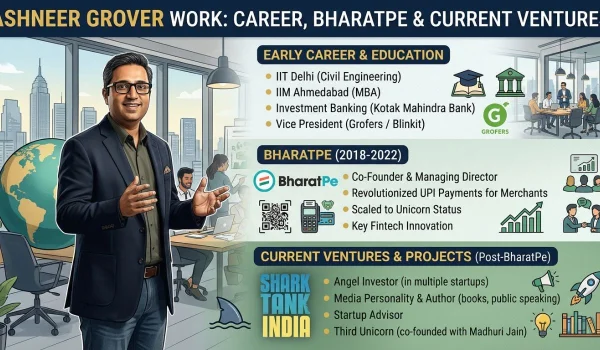
Ashneer Grover’s work spans investment banking, fintech, startup leadership, business investments, and television. He became widely known as the co-founder and former managing director of BharatPe, a financial technology company that helped merchants accept digital payments. His appearance on Shark Tank India later introduced him to a much larger audience.
After leaving BharatPe in 2022, Grover continued building businesses through Third Unicorn, a venture associated with fintech products and other entrepreneurial projects. His professional journey includes notable business growth, public controversies, a settlement with BharatPe, and new ventures aimed at solving financial problems.
Understanding Ashneer Grover’s work requires looking beyond his television personality. His career offers insights into startup funding, business models, leadership, risk-taking, and the challenges founders face when their interests conflict with those of investors or company boards.
Who Is Ashneer Grover?
Ashneer Grover is an Indian entrepreneur and former fintech executive best known for co-founding BharatPe and appearing as an investor on the first season of Shark Tank India. His professional background includes investment banking, corporate finance, and startup operations.
He gained recognition for his direct communication style and his focus on business fundamentals, including revenue, margins, customer acquisition, and company valuation. After his departure from BharatPe, he established Third Unicorn with his wife, Madhuri Jain Grover, and continued exploring entrepreneurial opportunities.
Ashneer Grover’s Quick Facts and Biography
| Detail | Information |
| Full name | Ashneer Grover |
| Nationality | Indian |
| Profession | Entrepreneur, investor, and author |
| Known for | BharatPe and Shark Tank India |
| Education | IIT Delhi and IIM Ahmedabad |
| Former leadership role | Co-founder and managing director of BharatPe |
| Later business venture | Third Unicorn |
| Book | Doglapan: The Hard Truth about Life and Start-Ups |
| Spouse | Madhuri Jain Grover |
| Main industries | Fintech, entrepreneurship, and investments |
These details summarize his publicly known professional background. His current business activities should be distinguished from his former position at BharatPe.
Ashneer Grover’s Age, Birthplace, and Early Life
Ashneer Grover was born on June 14, 1982, in Delhi, India. His early life and education helped establish the foundation for his later career in finance and entrepreneurship.
Growing up in an academically oriented family, he pursued engineering before moving into business and finance. His educational choices gave him a technical foundation, while his subsequent professional experience introduced him to investment decisions, business operations, and financial management.
His career demonstrates how professionals can move from established financial institutions into the faster-moving environment of startups.
Ashneer Grover’s Family and Personal Background
Ashneer Grover is married to Madhuri Jain Grover, who has also been associated with his business ventures. The couple has two children and generally keeps much of their family life separate from their public business activities.
Madhuri previously held a senior role at BharatPe and later became associated with Third Unicorn. Their professional partnership has continued beyond Grover’s departure from BharatPe.
Although public interest in his family is considerable, his business decisions and publicly documented professional roles provide a more useful basis for understanding his work.
Ashneer Grover’s Education at IIT Delhi and IIM Ahmedabad
Grover studied civil engineering at the Indian Institute of Technology Delhi. He subsequently completed an MBA at the Indian Institute of Management Ahmedabad in 2006.
These institutions provided different but complementary foundations for his career. Engineering developed his analytical and problem-solving abilities, while business education introduced him to corporate finance, strategy, management, and investment analysis.
His education did not automatically guarantee entrepreneurial success. However, it helped prepare him for roles that required evaluating businesses, understanding financial performance, and making decisions under uncertainty.
Ashneer Grover’s Career Journey
Ashneer Grover’s professional journey began in established financial institutions before moving into startup leadership. Each position gave him experience with a different aspect of business, from investment banking and corporate finance to operating a growing company.
Early Career at Kotak Investment Banking
Grover began his professional career at Kotak Investment Banking, where he spent approximately seven years. His work in investment banking exposed him to corporate transactions, financial analysis, capital markets, and the relationship between businesses and investors.
Investment banking helped him understand how companies raise capital, assess financial opportunities, and communicate their value to potential investors.
This experience became relevant later when he helped BharatPe secure funding and expand its business.
Professional Experience at American Express
Grover later worked at American Express, where his professional responsibilities included investment-related work in India. This experience broadened his understanding of financial services and corporate decision-making.
Working in a large financial organization differs considerably from running a startup. Established institutions typically have defined procedures, reporting structures, and risk controls. Startups, by comparison, often need to make decisions quickly while managing limited resources.
Exposure to both environments helped Grover develop a perspective that combined financial discipline with an appetite for rapid business growth.
Joining Grofers as Chief Financial Officer
Grover joined Grofers, now known as Blinkit, as a founding team member and chief financial officer. The company operated in the online grocery delivery market, where customer acquisition, logistics, pricing, and operational efficiency were important business challenges.
As CFO, he worked in a role closely connected to financial planning, fundraising, and business operations.
This position gave him experience with the practical demands of scaling a startup. Unlike investment banking, where professionals advise or evaluate transactions, a startup finance role requires ongoing involvement in the company’s financial health and operating decisions.
Working at PC Jeweller
Grover subsequently worked with PC Jeweller, where he was involved in developing its gold-loan business.
This role exposed him to a different area of financial services: lending secured against gold. Gold loans depend on collateral valuation, customer repayment capacity, lending terms, and risk management.
The experience was relevant to his later work in fintech, where lending and financial products became important parts of the broader business strategy.
How His Previous Jobs Prepared Him for Entrepreneurship
Grover’s career combined several useful capabilities:
- Financial analysis: Investment banking helped him evaluate companies, transactions, and financial opportunities.
- Fundraising experience: His finance background prepared him to work with investors and communicate a company’s growth potential.
- Operational management: His role at Grofers exposed him to the challenges of running a growing business.
- Financial-services knowledge: His work at American Express and PC Jeweller gave him experience with financial products and lending.
- Business strategy: His combined experience helped him identify customer problems that could support new business models.
These experiences formed a practical foundation for his work at BharatPe. They also illustrate why successful founders often benefit from understanding both the financial and operational sides of a company.
Ashneer Grover and BharatPe
BharatPe was the defining business chapter of Grover’s career. The company focused on helping merchants accept digital payments and access financial services, particularly in a market where small businesses needed convenient alternatives to traditional payment infrastructure.
Grover joined the founding team in 2018 and became a prominent leader during its expansion. The company subsequently developed a broader range of merchant-focused financial products.
How Ashneer Grover Co-Founded BharatPe
BharatPe was established in 2018 by a founding team that included Ashneer Grover, Shashvat Nakrani, and Bhavik Koladiya. The business focused on a practical problem: small merchants needed an easy way to accept digital payments without the complexity associated with traditional payment systems.
India’s growing adoption of UPI created an opportunity to develop payment tools for local retailers, restaurants, and other small businesses.
BharatPe used this opportunity to build a merchant network and later expanded into lending and other financial services.
What Was Ashneer Grover’s Role at BharatPe?
Grover served as co-founder and managing director. His work involved business strategy, fundraising, growth, and expanding the company’s merchant-focused services.
His responsibilities included helping the business attract investors, develop its commercial model, and compete in India’s rapidly changing fintech market.
As the company grew, he became one of its most visible representatives. However, the company was built by a broader team, and its development also depended on employees, investors, business partners, and other founders.
BharatPe Business Model: How the Fintech Company Made Money
BharatPe initially attracted merchants with payment acceptance tools and subsequently expanded into financial services.
Its broader business model included several activities:
- Merchant payments: Helping businesses accept digital payments through UPI QR codes.
- Merchant lending: Connecting eligible businesses with credit products and lending partners.
- Financial services: Expanding the range of products available to its merchant network.
- Related business operations: Developing services that could increase merchant engagement and create additional revenue opportunities.
The important distinction is that payment acceptance and lending generate value in different ways. Payment tools can help a company attract merchants, while lending and related financial products may provide additional revenue.
A successful fintech business must also manage operating expenses, technology costs, credit risk, regulatory obligations, and customer support.
How BharatPe Used UPI QR Codes to Help Small Businesses
Unified Payments Interface, or UPI, allows users in India to transfer money between participating bank accounts through supported payment applications.
BharatPe helped merchants accept UPI payments using QR codes. Customers could scan a code with a compatible payment application and transfer money electronically.
For small retailers, this approach reduced dependence on cash and made digital payment acceptance more convenient. It also helped BharatPe establish relationships with merchants who might later use other financial services.
The broader lesson is that a useful entry-level product can help a fintech company build distribution for additional services. However, acquiring customers does not automatically make a business profitable; the company must also develop sustainable revenue streams.
BharatPe’s Funding, Investors, and Valuation
BharatPe attracted substantial investor interest as it expanded its merchant network and financial-services offerings. In 2021, the company reached a reported valuation of approximately $2.85 billion.
That valuation reflected investor expectations about its growth potential at the time. It was not the same as the company’s revenue, profit, or cash available to shareholders.
Startup valuations generally depend on factors such as:
- Revenue growth and expected future earnings.
- Customer and merchant acquisition.
- Market size and competitive position.
- Technology and distribution advantages.
- Funding conditions and investor expectations.
- Business risks and the likelihood of achieving future targets.
BharatPe’s fundraising success helped make Grover a recognizable name in India’s startup ecosystem.
Ashneer Grover’s Leadership and Business Growth Strategy
Grover’s leadership style emphasized aggressive growth, decisive action, and a strong focus on business performance. During BharatPe’s expansion, the company sought to increase merchant adoption and build a broader fintech offering around its payment infrastructure.
Several elements of this approach are worth examining.
First, a product should solve a specific customer problem. BharatPe’s QR-based payment acceptance addressed a practical need for merchants.
Second, distribution matters. Building a merchant network created opportunities to introduce additional financial products.
Third, fundraising can support expansion, but capital must be converted into durable business value. A company needs strong controls, sound unit economics, and effective governance as it grows.
These principles are useful beyond BharatPe, although aggressive execution must be balanced with accountability and responsible management.
Why Ashneer Grover Left BharatPe
Grover’s departure followed a public dispute involving the company’s management, internal review, and allegations of financial irregularities.
In early 2022, BharatPe’s board took action against members of its leadership team, including Madhuri Jain Grover. Ashneer Grover resigned as managing director and director in March 2022.
The dispute became a major topic in Indian business news. It raised questions about founder accountability, internal controls, related-party transactions, and the responsibilities of company boards.
The allegations and Grover’s responses should be understood as part of a contested dispute, rather than treated as proof of every claim made by either side.
BharatPe Controversy, Investigation, and Settlement
The disagreement between Grover and BharatPe involved legal claims and allegations relating to company funds and corporate governance. The parties disputed aspects of the controversy, which continued after Grover left the company.
On September 30, 2024, BharatPe announced a settlement with Grover. Under the agreement, he would no longer be associated with BharatPe in any capacity. Certain shares were to be transferred to the Resilient Growth Trust for the company’s benefit, while his remaining shares would be managed through his family trust. Both parties agreed not to pursue their respective legal claims against each other.
The settlement ended the central dispute between the parties without requiring readers to assume that every allegation had been established as fact.
For the company’s official position and the reported settlement terms, readers can consult this Indian Express report on the BharatPe settlement.
What Happened to Ashneer Grover’s Ownership Stake in BharatPe?
The settlement changed Grover’s relationship with BharatPe. He ceased to be associated with the company and would no longer remain part of its shareholding in the manner described in the settlement announcement.
Certain shares were designated for transfer to the Resilient Growth Trust, while the remaining shares were to be managed through his family trust.
This distinction matters when evaluating his current business interests. His former role at BharatPe does not mean he continues to manage its operations or has the same ownership position he held before the settlement.
Ashneer Grover’s Work After BharatPe
After leaving BharatPe, Grover continued pursuing business opportunities through Third Unicorn and its associated ventures. These projects moved beyond the merchant-payment model that made him famous and explored areas such as healthcare financing, employee lending, and fantasy sports.
The status of individual products can change, so a company’s current operations should be distinguished from an earlier announcement or launch.
What Is Third Unicorn Private Limited?
Third Unicorn is a company associated with Ashneer Grover, Madhuri Jain Grover, and co-founder Aseem Ghavri. It became the platform for Grover’s post-BharatPe entrepreneurial activities.
The company attracted attention because Grover was returning to entrepreneurship after a highly publicized business dispute. Its projects have included financial technology and consumer-facing products.
Third Unicorn’s approach also reflects a common startup strategy: test business ideas, identify a market with a clear problem, and develop a product around the needs of a specific customer group.
Why Ashneer Grover Founded Third Unicorn
Third Unicorn gave Grover a vehicle for building new businesses independently of BharatPe. Its projects allowed him to explore markets where financial services, digital platforms, and consumer needs intersect.
The company’s work is best understood as a new chapter rather than a continuation of his former executive position.
Building another company after a public setback can offer an entrepreneur the opportunity to apply previous lessons. However, the new business must still establish its own customer demand, operating model, financial discipline, and long-term sustainability.
What Is ZeroPe, and How Does It Work?
ZeroPe is a healthcare-financing initiative associated with Third Unicorn. It was presented as a way to help eligible patients manage medical expenses through loans arranged with lending partners.
The proposed model connects healthcare payments with formal credit, potentially helping patients cover expenses that they cannot pay immediately.
A healthcare-financing platform may need to coordinate among patients, hospitals, technology providers, and regulated lenders. Its practical usefulness depends on loan eligibility, interest rates, fees, repayment terms, hospital participation, and the availability of credit.
Readers considering any medical loan should review the lender’s identity, annualized borrowing cost, repayment schedule, and applicable terms before accepting an offer. A platform’s promotion does not guarantee approval or make borrowing appropriate for every patient.
What Is CrickPe? Features and Business Model
CrickPe was a fantasy cricket platform associated with Third Unicorn. It entered a competitive market where users participate in fantasy contests based on real cricket matches.
Such platforms generally require users to select players and compete according to scoring rules tied to their performances. Depending on the product and contest, users may participate in private or public competitions.
CrickPe was intended to compete in India’s established fantasy-sports market. However, CrickPe subsequently shut down, so older articles describing it as an active platform may be outdated.
Its history illustrates a key point about startup work: launching a product and attracting attention do not guarantee long-term commercial viability. Competition, user acquisition costs, regulation, and retention can all affect a platform’s future.
What Is FundMyStaff, and Who Is It For?
Fund My Staff is an employee-focused lending platform launched by Third Unicorn in 2026. It aims to help employees access small-ticket personal loans by allowing employers to act as guarantors.
The model targets a problem faced by workers who have limited credit histories and may struggle to qualify for traditional loans. According to reporting by Inc42 in July 2026, the lending arrangement involves Ash Grove Capital, an RBI-registered non-banking financial company.
The intended users include employees who need access to formal credit and employers seeking to support their staff. The platform’s practical value depends on loan eligibility, the employer’s role, repayment arrangements, and the lender’s terms.
Employees should understand whether the employer has any financial liability, what happens if employment ends, and how missed payments affect them before accepting a loan.
Third Unicorn’s Products, Funding, and Business Strategy
Third Unicorn’s projects show an interest in developing businesses around specific customer needs rather than relying on a single product category.
| Venture | Main focus | Business objective |
| ZeroPe | Healthcare financing | Help eligible patients manage medical expenses |
| Fund My Staff | Employee-focused lending | Expand access to small-ticket credit |
| CrickPe | Fantasy cricket | Enter the fantasy-sports market; the platform later shut down |
The company’s ventures have different operating requirements. Healthcare financing requires coordination with medical providers and lenders, while employee lending involves credit assessment and repayment arrangements. Fantasy sports depends on user engagement, platform operations, and the applicable regulatory environment.
A diversified portfolio of ideas can create opportunities, but it also spreads management attention across different markets. The long-term success of each venture depends on execution, customer demand, economics, and compliance.
For a recent overview of Fund My Staff and Third Unicorn’s evolving portfolio, see Inc42’s July 2026 report.
What Is Ashneer Grover Working on Now?
As of October 2026, Grover’s publicly reported entrepreneurial activities include Third Unicorn and its newer fintech initiatives, particularly Fund My Staff. ZeroPe has also been associated with the company’s healthcare-financing plans.
CrickPe, by contrast, has shut down. Its earlier launch should not be mistaken for evidence that it remains operational.
Grover’s current work is therefore best described as entrepreneurship focused on new business development, especially financial services. Product availability, commercial scale, and company performance should be assessed using recent reporting rather than old launch announcements.
Ashneer Grover’s Investments and Business Portfolio
Ashneer Grover’s investment background includes corporate finance, startup fundraising, and business development. His public profile has also led many readers to search for his portfolio companies, investment strategy, and returns.
However, a founder’s business associations are not necessarily the same as personal investments. A company he founded, a business he advised, and a startup in which he personally invested represent different relationships.
Ashneer Grover’s Investment Strategy
Grover’s professional background suggests a strong interest in business fundamentals and growth potential. His public comments and television appearances have frequently focused on whether a business can acquire customers, generate revenue, manage costs, and achieve sustainable margins.
When assessing a startup, an investor generally needs to consider:
- The size and accessibility of the target market.
- The problem the product solves.
- Customer willingness to pay.
- Revenue model and gross margins.
- Customer acquisition costs and retention.
- Competition and defensibility.
- Management capability and governance.
- Capital requirements and the path toward profitability.
These are general investment principles, not a complete statement of Grover’s private investment criteria. His actual decisions may vary depending on the business, the terms of a deal, and the stage of the company.
Startups and Companies Associated With Ashneer Grover
The most clearly documented company associated with Grover’s entrepreneurial career is BharatPe, which he co-founded and later left. Third Unicorn is the principal business associated with his subsequent entrepreneurial activities.
ZeroPe, Fund My Staff, and CrickPe have been linked to Third Unicorn’s product development. Their association with the company does not automatically establish that Grover personally owns every underlying asset or holds an identical stake in every product.
His earlier work at Kotak Investment Banking, American Express, Grofers, and PC Jeweller should also be distinguished from ownership. Employment and executive responsibilities do not necessarily indicate a personal equity investment.
Ashneer Grover’s Portfolio Companies and Investments
There is no single publicly verified list that should automatically be treated as a complete account of every personal investment made by Grover.
A reliable portfolio profile should distinguish among four categories:
- Founder ownership: Businesses he established or co-founded.
- Executive positions: Companies where he worked in a management role.
- Publicly disclosed investments: Businesses in which a personal investment has been documented.
- Board or advisory associations: Companies where he held a formal governance or advisory position.
These categories matter because they reflect different levels of financial exposure, control, and responsibility.
Third-party databases may list company affiliations, directorships, or historic relationships. Such records can help identify possible connections, but they should be checked against corporate filings and reliable disclosures before being presented as a confirmed personal investment portfolio.
Ashneer Grover’s Portfolio Exits
An investment exit occurs when an investor sells or otherwise disposes of an ownership interest. An exit can happen through a company acquisition, a secondary share sale, a merger, or a public listing.
Grover’s departure from BharatPe was a change in his company association governed by a settlement, rather than a conventional startup acquisition that should automatically be described as a profitable investment exit.
A complete account of his personal portfolio exits would require verifiable information about the investment, the original stake, the transaction terms, and any proceeds. Without those details, claims about individual exit profits would be speculative.
Ashneer Grover’s Portfolio Unicorns
A unicorn is a privately held startup valued at $1 billion or more. The label refers to a company’s valuation, not necessarily its revenue, profitability, or the wealth of each founder.
BharatPe reached a reported valuation of approximately $2.85 billion in 2021 during Grover’s tenure. This makes it an important part of his professional association with a high-valued startup.
However, the company’s valuation at that time should not be interpreted as Grover’s personal net worth. His financial interest depended on his ownership stake, the terms attached to his shares, and subsequent changes in ownership.
Ashneer Grover’s Board Memberships
Grover’s professional history includes senior corporate positions and company affiliations. To determine which board roles he currently holds, readers should consult current corporate records rather than rely on older biographies.
A board directorship is different from serving as a founder, investor, or operating executive. Directors generally have governance responsibilities, while executives manage day-to-day operations.
Company databases can provide useful starting points, but appointment dates, current status, and formal designations should be verified against the relevant corporate registry.
How to Verify Ashneer Grover’s Investments and Startup Deals
Readers researching Grover’s investments can use a simple verification process:
- Identify the exact company and its legal name.
- Look for an official funding announcement or investor disclosure.
- Check corporate filings where ownership information is available.
- Confirm whether the relationship is an investment, employment role, directorship, or advisory position.
- Check the date of the information because company relationships can change.
- Distinguish an announced funding valuation from a completed transaction or realized return.
This approach reduces the risk of confusing a professional association with a personal financial investment.
What Is Publicly Known About His Investment Returns?
A complete, independently verified record of Grover’s personal investment returns is not publicly established. Company valuations and funding announcements do not reveal how much an individual investor ultimately earned.
To calculate an investment return, a researcher would need details such as the original investment amount, ownership percentage, dilution from later funding rounds, exit proceeds, and any relevant fees or taxes.
Without those figures, claims about his total investment profits should be treated cautiously.
Ashneer Grover on Shark Tank India
Shark Tank India helped introduce Grover to audiences beyond the startup and finance communities. His direct feedback, strong reactions, and focus on commercial viability became defining features of his public image.
Ashneer Grover’s Role as a Shark
Grover appeared as an investor on the first season of Shark Tank India. The show gives entrepreneurs an opportunity to pitch their businesses to investors and negotiate potential deals.
As a shark, Grover evaluated businesses by considering their market opportunities, financial performance, founders, and investment terms. His background in finance and startup operations influenced how he approached these discussions.
Television appearances can reveal aspects of an investor’s decision-making, but they do not provide a complete record of their private investment activity.
Ashneer Grover’s Most Memorable Pitches and Investments
Grover became widely recognized for his blunt responses to entrepreneurs and his willingness to challenge their assumptions.
His most memorable moments often involved questions about valuation, revenue, profitability, competition, and the founders’ understanding of their own businesses.
When evaluating any reported television deal, it is important to distinguish between an offer made on camera and an investment that was subsequently finalized. Not every televised agreement necessarily results in a completed transaction on the original terms.
His Investment Philosophy and Deal-Making Style
Grover’s television persona emphasized commercial logic and direct questioning. He often pushed founders to explain why their businesses deserved a particular valuation and how they planned to generate sustainable returns.
His approach highlights several useful questions for entrepreneurs:
- Can you explain your business model clearly?
- Do your customers have a strong reason to buy?
- Are your revenue and costs properly understood?
- What makes your product different from competitors?
- How much capital do you need, and what will it achieve?
- Can the business grow without its costs increasing too quickly?
Investors may disagree about how aggressively these questions should be asked. The underlying objective, however, is to understand whether a business can deliver lasting value.
What Entrepreneurs Can Learn From Ashneer Grover’s Shark Tank Decisions
Entrepreneurs can learn from the financial questions that frequently arise during investor pitches, regardless of whether they agree with Grover’s personal style.
First, founders should understand their numbers. Revenue, gross margin, operating expenses, customer acquisition costs, and cash flow reveal more about a business than popularity alone.
Second, a valuation needs a clear justification. A large market opportunity does not automatically mean that a startup deserves a high valuation.
Third, founders should know their competitive advantage. If competitors can easily copy the product or undercut its price, growth may become difficult to sustain.
Finally, communication matters. A founder who understands the business and can explain its risks honestly is better prepared for investor scrutiny.
Why Ashneer Grover Left Shark Tank India
Grover was associated with the first season of Shark Tank India and did not continue as a judge in subsequent seasons.
His departure from the show should be distinguished from his departure from BharatPe. The two involved different organizations and circumstances.
His visibility on television continued to shape his public identity even after his formal involvement with the program ended.
Ashneer Grover’s Books and Television Career
Beyond business operations, Grover developed a public profile through publishing and television. These activities gave him additional ways to discuss entrepreneurship, personal setbacks, and his views on corporate life.
Doglapan: The Hard Truth About Life and Start-Ups
Grover wrote Doglapan: The Hard Truth about Life and Start-Ups, published by Penguin Random House India.
The book discusses his personal and professional journey, including his experience building BharatPe and his perspective on the pressures of startup life. It combines business reflections with personal accounts and commentary on the challenges of ambition, competition, and corporate relationships.
Readers can find the author’s official book listing through Penguin Random House India’s Ashneer Grover page.
Key Lessons From Ashneer Grover’s Book
The book offers readers a window into Grover’s perspective on building businesses and navigating professional setbacks. Its lessons are best understood as the author’s views and experiences rather than universal rules.
Key themes include:
- Ambition and execution: Business ideas need disciplined action to become viable companies.
- Understanding money: Founders must know their financial position and the economics behind growth.
- Managing relationships: Relationships among founders, investors, and employees can influence company outcomes.
- Handling setbacks: Professional difficulties can change an entrepreneur’s priorities and future decisions.
- Understanding organizational power: A founder’s influence can depend on governance structures, ownership, and the board’s authority.
Readers should evaluate the book critically, comparing the author’s account with other reliable information where disputes or contested events are involved.
Rise and Fall: Ashneer Grover’s Television Show
Rise & Fall is a reality television program associated with Grover as its host. The show’s format centers on competition, changing power dynamics, and participants navigating different levels of influence.
Its themes overlap with public interest in leadership, ambition, strategy, and decision-making under pressure.
However, a reality television format is designed for entertainment. Its outcomes should not be treated as scientific evidence about business leadership or as a direct measure of an individual’s professional capabilities.
How Television and Personal Branding Influenced His Entrepreneurial Image
Television helped transform Grover from a fintech executive into a widely recognized business personality. His concise, confrontational style made him memorable to viewers and generated discussion around startup pitches.
A strong public profile can help entrepreneurs attract attention to new ventures, communicate their ideas, and build recognition. It can also increase scrutiny when controversies arise.
For business founders, the broader lesson is that personal branding can support a company, but it cannot replace customer demand, operational quality, financial discipline, or effective governance.
Ashneer Grover’s Net Worth, Income, and Assets
Ashneer Grover’s net worth is a frequent subject of online searches, but a precise current figure should not be treated as confirmed without reliable financial disclosures.
His wealth may be influenced by business ownership, investments, compensation, and other assets. These sources are difficult to value accurately when private holdings, liabilities, and transaction terms are not fully public.
What Is Ashneer Grover’s Estimated Net Worth?
Various online profiles publish estimates of Grover’s net worth, but such figures can differ substantially. Without an independently verified and current financial statement, no specific estimate should be presented as an established fact.
A reliable net-worth calculation would require information about his current assets, business interests, investments, liabilities, and any realized proceeds from previous holdings.
His former association with a multibillion-dollar startup does not establish that he personally possessed wealth equal to a corresponding fraction of its headline valuation.
Main Sources of Ashneer Grover’s Income
Grover’s professional history points to several possible sources of earnings over time:
- Compensation from previous executive positions.
- Proceeds or financial interests connected with business ownership.
- Returns from investments, where applicable.
- Income from books and related publishing activities.
- Compensation or commercial opportunities associated with television and public appearances.
- Financial interests connected with his subsequent ventures.
The existence of a potential income source does not confirm its current value or contribution to his total wealth.
BharatPe Stake, Startup Investments, and Business Ownership
Grover’s relationship with BharatPe changed substantially following the 2024 settlement. The settlement terms addressed his association and shareholding, so older accounts of his stake should not be assumed to reflect his current financial position.
His association with Third Unicorn and its ventures represents a separate business chapter. However, company ownership, the value of a business, and an individual’s personal wealth are different measurements.
A startup can have valuable intellectual property or promising products without generating large profits. Likewise, a founder’s ownership stake may be subject to dilution, restrictions, or other contractual terms.
Net Worth Estimates vs. Verified Financial Information
When evaluating celebrity or entrepreneur wealth estimates, readers should consider the quality of the underlying evidence.
A useful distinction is:
| Financial term | Meaning |
| Revenue | Money a business earns from its activities |
| Profit | Revenue remaining after applicable expenses |
| Valuation | An estimate of a company’s worth under specific conditions |
| Equity stake | An ownership interest in a company |
| Realized gain | Profit actually secured through a completed transaction |
| Net worth | The value of personal assets minus liabilities |
These terms are not interchangeable. A company valuation may rise without creating immediate cash for its founders, and a founder may own shares that cannot readily be sold.
Is Ashneer Grover a Billionaire?
There is no sufficient basis to state that Grover is currently a billionaire in US-dollar terms as a verified fact.
Such a claim would require credible evidence of his personal net worth, not simply the valuation of a company he previously co-founded. His financial position may have changed following the BharatPe settlement and his subsequent business activities.
The most accurate approach is to treat unverified online net-worth figures as estimates rather than confirmed financial disclosures.
Ashneer Grover’s Leadership Style and Business Philosophy
Grover’s leadership style became part of his public identity through his work at BharatPe and his appearances on television. He is associated with direct communication, high expectations, and a strong emphasis on commercial performance.
These characteristics can attract attention and encourage decisive action, but effective leadership also requires sound judgment, accountability, and respect for organizational processes.
His Approach to Startup Growth and Competition
Grover’s business history highlights the importance of identifying a clear customer problem and building a product that can reach customers efficiently.
BharatPe’s merchant-focused payment tools illustrate this approach. Rather than relying only on a broad fintech concept, the company offered a practical product for merchants and developed opportunities around that customer relationship.
However, rapid growth creates its own challenges. As a startup expands, it must build reliable systems for hiring, financial reporting, compliance, customer support, and risk management.
A company that grows faster than its internal controls can manage may face avoidable operational and governance problems.
Ashneer Grover’s Communication Style and Public Image
Grover is known for speaking directly and challenging assumptions. On television, this style often made business discussions more engaging for viewers.
Direct communication can help teams identify problems quickly. However, tone and context matter. A message that sounds decisive in a televised pitch may not be appropriate for every workplace situation.
Effective leaders must communicate expectations clearly while creating an environment where employees can raise concerns, explain mistakes, and challenge decisions without fear of retaliation.
His Views on Founders, Investors, and Business Risks
The disputes surrounding BharatPe demonstrate how relationships between founders, investors, and boards can become complicated as companies grow.
Founders may prioritize speed, product development, and control over strategic decisions. Investors and boards must also consider financial reporting, legal compliance, risk management, and the interests of other shareholders.
These responsibilities can conflict, especially when the company faces pressure to grow quickly.
A strong governance structure defines decision-making authority, documents transactions, manages conflicts of interest, and establishes independent oversight. Such systems protect the company even when relationships among senior leaders deteriorate.
Business Lessons From Ashneer Grover’s Successes and Setbacks
Grover’s career offers several lessons for aspiring founders.
Solve a real problem. BharatPe’s original payment tools addressed a practical need among merchants. Businesses are more likely to attract customers when they provide a clear benefit.
Understand the economics. Growth is useful only when the company has a credible path to sustainable financial performance.
Build reliable governance. Clear approval processes, independent oversight, and accurate financial records become increasingly important as a company grows.
Separate personal relationships from business controls. Related-party transactions should receive appropriate scrutiny, regardless of the people involved.
Manage reputation carefully. Public communication can strengthen a founder’s brand, but disputes and controversial behavior may affect employees, investors, customers, and future opportunities.
Learn from changing market conditions. A product that attracts attention at launch may still struggle to retain customers or operate profitably.
These lessons apply broadly to startups and are not dependent on accepting every aspect of Grover’s public persona.
Criticism of His Leadership Style and Public Controversies
Grover’s public image has attracted both attention and criticism. Some audiences value his direct approach to business discussions, while others question whether confrontational communication is an effective leadership model.
His departure from BharatPe also drew attention to governance and financial-control concerns. Those issues should be discussed with careful attention to documented events, the parties’ respective positions, and the terms of the eventual settlement.
A balanced assessment separates his business achievements from questions about leadership and corporate conduct. Success in building a company does not eliminate the need for accountability, and controversy alone does not provide a complete assessment of a person’s professional abilities.
Ashneer Grover’s Wife, Family, and Personal Life
Ashneer Grover’s family has attracted public attention partly because his wife, Madhuri Jain Grover, has also been associated with his business career.
Their professional and personal lives overlap in some areas, but not every private detail is relevant to understanding Grover’s work.
Who Is Ashneer Grover’s Wife, Madhuri Jain Grover?
Madhuri Jain Grover is an entrepreneur and business professional who previously worked at BharatPe, where she held a senior role related to internal controls. She later became associated with Third Unicorn.
Her professional history became part of the public dispute surrounding BharatPe. Allegations and claims made during that dispute should not be confused with independently established findings about every aspect of her conduct.
Her association with Third Unicorn reflects the couple’s continued involvement in business after leaving BharatPe.
Ashneer Grover’s Children and Family Life
Grover and Madhuri have two children. The family generally keeps their children’s private lives separate from his public business identity.
Although audiences may be interested in the personal side of well-known entrepreneurs, detailed speculation about family matters does not help readers understand the performance or strategy of their businesses.
How He Balances Business and Personal Life
There is limited independently verified information about Grover’s daily family routines or how he organizes his personal time.
As with many founders, running businesses and managing public commitments can create competing demands. However, without direct and reliable information, claims about his specific work-life balance would be speculative.
What Ashneer Grover Keeps Private About His Personal Life
Grover shares some aspects of his professional experiences publicly through interviews, television, and writing. Other details about his family and private routines are not comprehensively documented.
A useful biography should respect that distinction. Public information about education, company roles, and documented business events can be discussed without speculating about private matters.
Ashneer Grover’s Current Business Activities and Future Plans
Grover’s current business activity is best understood through his publicly reported ventures rather than assumptions based on his earlier position at BharatPe.
As of October 2026, Third Unicorn and its associated financial-services initiatives are important parts of this picture. The status of individual products can change, so recent announcements should be distinguished from active operations and demonstrated commercial results.
His Latest Publicly Confirmed Business Ventures
Fund My Staff is among Grover’s recent reported ventures. Launched in 2026, it focuses on small-ticket lending for employees, with employers acting as guarantors under the intended model.
ZeroPe has also been associated with Third Unicorn’s plans for healthcare financing. These products address different financial needs, but both depend on effective lending arrangements, suitable risk assessment, and clear customer terms.
CrickPe, in contrast, has shut down. Its earlier launch is part of Grover’s business history rather than evidence of an active product today.
Third Unicorn’s Current Business Direction
Third Unicorn’s recent projects suggest a focus on targeted financial services. Instead of concentrating exclusively on merchant payment acceptance, the company has explored healthcare-related borrowing and employee credit access.
These markets present opportunities but also require careful management. Lending products must account for repayment risk, customer eligibility, disclosure requirements, and applicable regulation.
The company’s longer-term direction will depend on whether its products attract and retain users while developing sustainable economics.
New Startup Investments and Entrepreneurial Opportunities
There is no need to assume that every new company or product associated with Grover is a personal investment. A founder may establish a business, develop a product, work with co-founders, or invest separately in another company.
Future opportunities for entrepreneurs in financial technology may include improving access to credit, reducing friction in financial services, and creating tools for underserved customer groups.
Whether any particular opportunity becomes one of Grover’s next ventures depends on actual announcements and reliable reporting.
What to Watch for in Ashneer Grover’s Next Career Chapter
Readers following Grover’s work can look for several meaningful indicators:
- Official announcements confirming a product’s launch and availability.
- Evidence of customer adoption and repeat usage.
- Funding disclosures and credible information about company ownership.
- Financial performance and progress toward sustainable operations.
- Regulatory compliance and the identity of lending partners.
- Changes in company leadership or product status.
These indicators offer a more reliable picture of business progress than publicity or launch announcements alone.
Ashneer Grover’s Impact on India’s Startup Ecosystem
Grover’s career reflects several important developments in India’s startup economy, including the growth of digital payments, the expansion of fintech services, the rise of televised startup investing, and greater public attention to founder governance.
His experience provides a useful case study in both entrepreneurial opportunity and the pressures that come with scaling a company.
His Contribution to Fintech and Digital Payments
Through BharatPe, Grover was associated with a business that helped merchants accept digital payments and later expanded into other financial services.
The broader growth of UPI and digital payment infrastructure created opportunities for fintech companies to serve small businesses. Merchant-facing products helped make electronic payments more accessible to retailers that might otherwise have relied heavily on cash.
BharatPe was one participant in a much larger ecosystem that includes banks, payment applications, regulators, technology providers, and other fintech businesses. Its development should therefore be understood within the wider growth of digital finance in India.
Lessons for Indian Startup Founders
Founders can draw several practical lessons from Grover’s professional journey:
- Identify a clear customer problem before building a product.
- Understand the financial model, not just the market opportunity.
- Build distribution that can support long-term customer relationships.
- Raise capital with a clear plan for how it will be used.
- Establish sound governance and financial controls early.
- Treat investor and employee relationships as important business responsibilities.
- Adapt when market conditions or customer needs change.
These principles can help founders build more resilient businesses, even when their industries and business models differ from those in Grover’s career.
His Influence on Startup Investment and Entrepreneurship
Grover’s television appearances helped make startup investing more accessible to a broad audience. Viewers encountered discussions about company valuations, equity, revenue, margins, and negotiation in an entertainment format.
This visibility encouraged greater public interest in entrepreneurship and the mechanics of investment deals.
However, television presents a simplified version of investing. Real-world decisions require deeper due diligence, legal documentation, financial analysis, and ongoing evaluation of business performance.
What Aspiring Entrepreneurs Can Learn From His Career
The most useful lesson from Grover’s career is that entrepreneurship involves more than launching a promising product or attracting investors.
Building a lasting business requires a combination of market understanding, financial discipline, operational execution, and responsible leadership.
His experience at BharatPe shows the possibilities of scaling a business around a clear customer need. The subsequent dispute also highlights the importance of internal controls, board oversight, and transparent governance.
His later ventures demonstrate the continuing process of testing new ideas. Not every product succeeds, and a company’s future depends on how effectively it responds to customer needs, competition, and financial realities.
For aspiring founders, the goal should not be to copy a public personality. It should be to understand the decisions, systems, and trade-offs that influence a business over time.
Frequently Asked Questions About Ashneer Grover Work
What does Ashneer Grover do for work?
Ashneer Grover is an entrepreneur and former fintech executive. As of October 2026, his publicly reported business activities include Third Unicorn and its associated financial-services ventures, including Fund My Staff.
What company does Ashneer Grover own now?
Grover is associated with Third Unicorn, a company involved in developing new ventures. The exact ownership structure and interests in individual products should be checked against current corporate disclosures.
Is Ashneer Grover still associated with BharatPe?
No. BharatPe announced a settlement with Grover on September 30, 2024, under which he would no longer be associated with the company in any capacity.
Why did Ashneer Grover leave BharatPe?
He left after a public dispute involving company management, an internal review, and allegations of financial irregularities. The parties later reached a settlement in September 2024 and agreed not to pursue their respective legal claims against each other.
What is Third Unicorn, founded by Ashneer Grover?
Third Unicorn is a company associated with Grover, Madhuri Jain Grover, and Aseem Ghavri. It has been linked to ventures in financial services, including healthcare financing and employee-focused lending.
What are Ashneer Grover’s current businesses?
His recent reported ventures include Fund My Staff, which focuses on employee lending, and ZeroPe, a healthcare-financing initiative. CrickPe, his earlier fantasy-cricket venture, has shut down.
What companies has Ashneer Grover invested in?
BharatPe is his best-known former business association, and Third Unicorn is central to his later entrepreneurial work. A complete, verified list of his personal investments and returns is not publicly established.
What was Ashneer Grover’s job before BharatPe?
Before BharatPe, Grover worked at Kotak Investment Banking, American Express, Grofers, and PC Jeweller. His experience included investment banking, finance, startup operations, and gold-loan business development.
How did Ashneer Grover become famous?
He gained prominence through his work as BharatPe’s co-founder and managing director. His appearance as an investor on the first season of Shark Tank India significantly increased his public recognition.
What is Ashneer Grover’s educational qualification?
He studied civil engineering at IIT Delhi and completed an MBA at IIM Ahmedabad in 2006.
What is Ashneer Grover’s estimated net worth?
Various online sources publish estimates, but a precise current net worth has not been independently established through comprehensive public financial disclosures. His former company valuation should not be confused with his personal wealth.
Is Ashneer Grover still on Shark Tank India?
No. Grover appeared in the first season but did not continue as a judge in subsequent seasons.
What is Ashneer Grover’s book called?
His book is Doglapan: The Hard Truth about Life and Start-Ups. It discusses his career, entrepreneurial experiences, and personal perspective on startup life.
What is Ashneer Grover doing now?
As of October 2026, Grover’s publicly reported work centers on Third Unicorn and its financial-services initiatives, including Fund My Staff. The status and performance of individual ventures should be assessed using recent, reliable information.
Conclusion: Ashneer Grover’s Career, Work, and Business Legacy
Ashneer Grover’s career spans investment banking, startup finance, fintech leadership, television, publishing, and entrepreneurship. His work at BharatPe brought him prominence, while his subsequent ventures show his continued interest in developing businesses around financial needs.
His professional journey also highlights the importance of governance, accountability, and financial discipline. Rapid growth and public recognition can create opportunities, but they do not remove the need for strong internal systems and responsible leadership.
For anyone researching Ashneer Grover work, the clearest approach is to distinguish his former BharatPe role from his current entrepreneurial activities, separate verified facts from online estimates, and assess each business on its own merits. His career offers useful lessons about building companies, managing risk, and adapting after major professional setbacks.

Elliot Dyer is a Business Writer at Caption Disk, specializing in entrepreneurship, startups, business trends, and growth strategies. He shares practical insights and informative content to help readers stay updated on the business world.