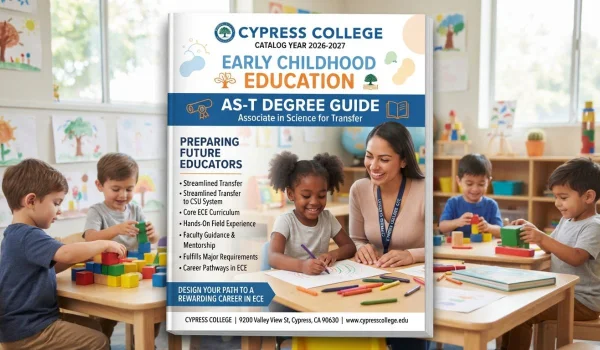
Quick Facts About Cypress College Early Childhood Education AS-T
The Cypress College Early Childhood Education AS-T search concerns an associate degree pathway for students who want to study child development, early learning, and education before transferring to a four-year university. The key first step is confirming whether Cypress College currently offers this exact degree title or a related program.
| Detail | What students should know |
| College | Cypress College, Cypress, California |
| Subject area | Early childhood education and child development |
| Degree type | AS-T means Associate in Science for Transfer |
| Main purpose | Prepare students for transfer to a participating California State University (CSU) program |
| Related pathway | Elementary Teacher Education AA-T or other education-related programs, if currently offered |
| Course requirements | Depend on the official catalog and the specific degree |
| General education | Must be checked against the applicable catalog and transfer pathway |
| Career direction | Early learning, preschool support, child development, or further teacher preparation |
Important: Do not assume that an Early Childhood Education AS-T listed on another college’s website is also available at Cypress College. Degree titles, course requirements, and transfer pathways can differ between institutions.
Key Takeaways for Prospective Students
- Verify the exact degree: Confirm Cypress College’s current degree and certificate offerings before planning your courses.
- Understand the AS-T: An Associate Degree for Transfer is designed to support transfer to the CSU system, subject to applicable eligibility and admission rules.
- Check course articulation: Use official college materials and ASSIST.org to confirm how courses apply to your intended university and major.
- Separate the degree from professional credentials: An associate degree does not automatically grant a California Child Development Permit or a teaching credential.
- Plan early: Academic counseling can help you avoid taking courses that do not satisfy your intended degree or transfer requirements.
- Compare alternatives: A related associate degree, certificate, or another community college pathway may better fit your career goals.
Does Cypress College Offer an Early Childhood Education AS-T?
The exact title matters. Students searching for the Cypress College Early Childhood Education AS-T should verify the current program list rather than assume that a degree offered by another California community college is available at Cypress.
Cypress College is part of the North Orange County Community College District. Its current academic catalog and official program pages are the appropriate places to confirm available majors, associate degrees, certificates, and transfer pathways.
Understanding the Difference Between Cypress College and Fullerton College
Cypress College and Fullerton College are separate colleges within the same district. They may share district resources, but their degree offerings, course schedules, and program requirements are not automatically identical.
A program page for Fullerton College does not establish that Cypress College offers the same AS-T. Before enrolling, confirm:
- Which college awards the degree.
- Whether the exact degree title appears in its current catalog.
- Which required courses are available at that college.
- Whether the program has a current CSU transfer pathway.
Where to Verify Current Early Childhood Education Degree Offerings
Start with the official Cypress College website and its current catalog. Search for Early Childhood Education, Child Development, Elementary Teacher Education, and Associate Degree for Transfer.
If the exact AS-T is not listed, contact an academic counselor to identify the closest appropriate pathway. Confirm the catalog year that applies to your enrollment, since requirements can change.
The current Cypress College transfer-degree listing includes Elementary Teacher Education AA-T, but it does not list an Early Childhood Education AS-T among its current Associate Degrees for Transfer. Students should confirm any catalog updates directly with the college before making enrollment decisions.
What Is an Early Childhood Education AS-T?
An Early Childhood Education Associate in Science for Transfer (AS-T) is a community college degree designed to prepare students to transfer into a related bachelor’s degree program at a California State University.
Early childhood education focuses on how young children develop, learn, communicate, and interact with others. Coursework may cover child development, classroom environments, curriculum planning, observation, family engagement, and children’s health and safety.
What Does Associate Degree for Transfer (AS-T) Mean?
An AS-T is one type of Associate Degree for Transfer (ADT) offered by participating California community colleges. It is designed to create a more structured pathway from a two-year college to a related CSU bachelor’s degree.
According to the California State University system, students who meet the applicable requirements receive guaranteed admission to the CSU system, but not necessarily to a particular campus or major. Students should check the official CSU Associate Degree for Transfer requirements before choosing their pathway.
Early Childhood Education AS-T vs. AA-T vs. Associate Degree
| Degree type | Main purpose | What to consider |
| AS-T | Transfer preparation in an approved field | Intended for a related CSU bachelor’s program |
| AA-T | Transfer preparation in an approved arts or related field | Also follows the ADT framework |
| Associate of Arts (AA) | General academic or career preparation | Transfer benefits depend on the degree and destination |
| Associate of Science (AS) | Scientific, technical, or career-oriented study | Transferability depends on the program |
| Certificate | Focused preparation in a specific subject or occupation | May not meet bachelor’s transfer requirements |
The degree title alone does not determine whether a program is transferable. Students should confirm the exact major, required coursework, and receiving university’s requirements.
Who Should Consider This Transfer Pathway?
An ECE AS-T may suit students who:
- Want to pursue a bachelor’s degree related to early childhood education.
- Are interested in teaching or supporting young children.
- Want a structured community college-to-CSU pathway.
- Prefer to complete lower-division coursework before transferring.
- Want to explore child development, preschool education, or early learning programs.
Students who want to become elementary school teachers should also investigate elementary teacher education and liberal studies pathways, since those routes may have different course requirements and credential implications.
⭐ Cypress College Early Childhood Education AS-T Requirements for 2026
Because the current Cypress College ADT listing does not include an Early Childhood Education AS-T, students should not rely on a course list published for Fullerton College or another institution as if it were a Cypress College degree checklist.
The best approach is to identify the degree Cypress College actually offers, then confirm whether it meets the student’s transfer and career goals.
Required Courses and Major Preparation
For a confirmed ECE AS-T at a college that offers it, major preparation may include subjects such as:
- Child growth and development.
- Early childhood education principles.
- Curriculum and learning environments.
- Observation and assessment of young children.
- Family, community, and cultural influences.
- Health, safety, nutrition, and child guidance.
- Supervised field experience or a teaching practicum, where required.
These are examples of common subject areas, not a verified Cypress College course list. Course numbers and requirements must come from the applicable college catalog.
General Education Requirements and Cal-GETC
General education (GE) courses develop skills in communication, critical thinking, quantitative reasoning, arts and humanities, social sciences, and other required areas.
California’s general education and transfer rules have changed over time. Students should follow the GE pattern and catalog requirements that apply to their specific program and enrollment circumstances rather than automatically using an older CSU GE-Breadth or IGETC checklist.
Ask a counselor to confirm:
- Which general education pattern applies to the intended degree.
- Whether major courses also satisfy a GE requirement.
- Whether completed courses can be certified for transfer.
- Whether additional lower-division prerequisites are needed for the intended bachelor’s program.
Minimum Units, GPA, and Grade Requirements
The exact unit total, minimum GPA, and minimum grades depend on the approved degree and its current catalog.
Many ADT pathways are structured around completing 60 semester units or 90 quarter units, including major and general education requirements. However, students should verify the specific program’s checklist and any additional admission criteria imposed by the receiving CSU campus or major.
Do not assume that completing 60 units alone earns an AS-T. The required major courses, general education certification, graduation application, and other applicable conditions must also be satisfied.
How to Check the Official Degree Checklist and Catalog
Use this verification process before registering for classes:
- Open the current Cypress College catalog and official transfer-degree listing.
- Search for the exact degree name and program requirements.
- Check whether the program is offered for the catalog year that applies to you.
- Review the required courses and any approved substitutions.
- Ask an academic counselor to review your transcript and transfer plan.
- Keep a copy of your education plan and check for catalog changes before registration.
This process is particularly important if you have already completed courses at another college or are considering taking classes at both Cypress and Fullerton College.
⭐ How Many Units Are Required for an Early Childhood Education AS-T?
The total depends on the approved degree and the college offering it. An ADT is generally designed around a 60-semester-unit or 90-quarter-unit framework, but students must complete the specific major and general education requirements for their program.
The unit count should be confirmed in the current catalog rather than copied from a different college’s program page.
Major Units vs. General Education Units
Major units cover the subject area of the degree, such as child development, early childhood curriculum, and assessment. General education units satisfy broader academic requirements.
Some courses may count toward both the major and a general education area when the applicable rules permit it. This can help students avoid unnecessary coursework, but the overlap must be confirmed by the college.
How Transferable Units Count Toward the Degree
Not every college unit necessarily applies to a particular degree or transfer major. The result depends on the course, its transfer status, the program requirements, and the receiving university.
Students should distinguish between:
- Units earned on a transcript.
- Units accepted as transferable credit.
- Units that satisfy the associate degree.
- Units that fulfill prerequisites for the bachelor’s degree.
These categories can overlap, but they are not interchangeable.
How Long Does It Take to Complete the Program?
A traditional 60-semester-unit associate transfer pathway may take about two years of full-time study. Actual completion time varies according to course availability, placement, previous credits, enrollment intensity, and whether required courses are offered every term.
Part-time students may need longer. Students with applicable transfer credit may finish sooner, provided all degree and graduation requirements are met.
What Will Students Learn in an Early Childhood Education Program?
Early childhood education programs help students understand children’s development and create environments that support learning, wellbeing, and social growth.
Child Growth and Development
Students examine how children develop physically, socially, emotionally, cognitively, and linguistically. They learn that development varies between children and that age-based expectations should not replace individual observation.
Early Childhood Curriculum and Learning Environments
Coursework may cover play-based learning, lesson planning, classroom routines, learning materials, and developmentally appropriate activities. Students explore how teachers create welcoming spaces where children can investigate, communicate, and build new skills.
Observation, Assessment, and Documentation
Observation helps educators understand children’s interests, strengths, and learning needs. Students may learn to document behavior, recognize developmental patterns, and use assessment information to plan appropriate activities.
Assessment should be interpreted carefully and within the educator’s professional role. It does not replace an evaluation by a qualified specialist when a developmental concern requires further assessment.
Family Engagement and Culturally Responsive Teaching
Early childhood educators work with families from different cultural, linguistic, and social backgrounds. Programs may address respectful communication, family partnerships, inclusive teaching practices, and the influence of home and community environments on learning.
Health, Safety, Inclusion, and Child Guidance
Students may study classroom safety, hygiene, nutrition, positive guidance, inclusive learning environments, and strategies for supporting children’s social and emotional development.
Some programs also include supervised practical experience. The specific requirements depend on the degree and the institution.
⭐ Can You Transfer From Cypress College to a CSU With an Early Childhood Education Degree?
Yes. Cypress College students can pursue transfer to a CSU in an appropriate education-related major. However, the best route depends on the associate degree they complete and the bachelor’s program they want to enter.
Since Cypress College lists Elementary Teacher Education AA-T rather than Early Childhood Education AS-T among its current ADTs, students interested in early childhood education should compare that pathway with related programs at other colleges.
How the Associate Degree for Transfer Pathway Works
The ADT pathway is intended to simplify transfer from a California community college to a related CSU bachelor’s degree.
In general, students must complete an approved AA-T or AS-T, satisfy applicable CSU eligibility requirements, apply by the relevant deadlines, and submit the required records. The transfer benefit depends on the degree being approved and its relationship to the receiving CSU major.
CSU Admission Eligibility vs. Admission to a Specific Major
Meeting CSU transfer eligibility does not mean a student will automatically enter any campus or major they choose.
Some campuses and programs are impacted, meaning they have more qualified applicants than available places. They may use additional selection criteria, including higher GPA thresholds or required preparatory courses.
Students should review both the general transfer requirements and the admission rules for their intended major.
Does an AS-T Guarantee Admission to Your Preferred CSU Campus?
No. An ADT provides a transfer pathway with guaranteed admission to the CSU system for eligible students, but it does not guarantee admission to a particular campus or major.
Priority consideration may apply to a similar major, subject to CSU rules and campus requirements. Students should build a backup plan that includes more than one campus when possible.
How to Research CSU Campuses Offering Related Majors
When comparing universities, consider:
- Whether the campus offers a bachelor’s degree in early childhood education, child development, or a related field.
- Whether the program accepts your intended associate degree for transfer.
- Whether additional prerequisites or supplemental applications are required.
- Whether the program prepares graduates for the career or credential they want.
- Whether the campus offers suitable class schedules, student support, and financial aid.
The CSU’s official ADT search tool can help students identify community colleges offering approved transfer degrees and CSU campuses with similar majors. Verify the results with a counselor before making a final decision.
Using ASSIST.org to Verify Course Articulation
ASSIST.org is California’s official resource for exploring course articulation and transfer agreements between public community colleges and universities.
Use it to investigate whether particular courses satisfy requirements for your intended transfer institution. Remember that course articulation is not the same as confirmation that Cypress College offers a particular degree. Both the degree and the course pathway must be verified.
⭐ Cypress College Alternatives for Students Interested in Early Childhood Education
Students who cannot find the exact ECE AS-T at Cypress College still have options. The right alternative depends on whether their priority is becoming an elementary school teacher, working in preschool, studying child development, or transferring into a bachelor’s degree.
Early Childhood Education Courses and Related Certificates
Ask Cypress College whether it currently offers individual child development courses, relevant certificates, or other coursework that supports your goals. A related course or certificate may provide useful preparation, but it should not be assumed to replace an approved AS-T.
Before enrolling, check the course prerequisites, program requirements, career relevance, and transferability.
Elementary Teacher Education AA-T
Cypress College’s current transfer-degree listing includes an Elementary Teacher Education AA-T. This may be a relevant option for students who want to continue toward a bachelor’s degree related to elementary teaching.
However, elementary teacher education and early childhood education are not identical. Students should compare the required courses and intended career outcomes before choosing between them.
Child Development and Education Pathways at Nearby Community Colleges
Nearby community colleges may offer early childhood education degrees, child development programs, or certificates that are not available at Cypress College.
Compare programs by checking:
- The exact degree awarded.
- Required major and general education courses.
- Transfer agreements and CSU destinations.
- Fieldwork or practicum requirements.
- Class availability and total expected cost.
- Whether the qualification supports the intended employment or permit pathway.
How to Compare Cypress College and Fullerton College
Fullerton College is a particularly relevant college to investigate because its official articulation listing includes an Early Childhood Education AS-T.
Cypress College and Fullerton College belong to the same district, but students should still compare the colleges’ official requirements rather than assuming their programs are interchangeable. Review the current catalog, course availability, transfer information, and counseling options before deciding where to complete the degree.
⭐ Can You Complete the Early Childhood Education AS-T at Fullerton College Instead?
Fullerton College is a potential alternative for students seeking an Early Childhood Education AS-T. Its official transfer-degree listing includes the ECE AS-T, whereas Cypress College’s current ADT list includes Elementary Teacher Education AA-T.
Students should use Fullerton College’s current catalog to confirm the requirements that apply to their intended start date. Older course lists and archived catalogs may not reflect the latest program revisions.
Fullerton College ECE Degree Requirements
An Early Childhood Education AS-T typically combines major coursework with transferable general education and other degree requirements. Relevant subjects may include child development, early childhood curriculum, observation and assessment, family and community, health and safety, and supervised teaching experience.
The exact course list, unit total, and minimum grade requirements must be confirmed in the current Fullerton College catalog. Do not use an older catalog as a substitute for current enrollment advice.
Comparing Course Availability, Units, and Transfer Options
When comparing Fullerton College with Cypress College, look beyond the degree title.
| Comparison point | What to check |
| Degree availability | Is the exact ECE AS-T currently offered? |
| Major requirements | Which courses must be completed? |
| General education | Which current GE pattern applies? |
| Course scheduling | Are required classes available when you need them? |
| Transfer destinations | Which CSU majors are considered similar? |
| Practical experience | Is fieldwork or a practicum required? |
| Total cost | What fees and additional expenses should you budget for? |
| Student support | Are counseling and transfer services available? |
The most convenient option is not necessarily the fastest. A good pathway is one that aligns with your intended bachelor’s degree and minimizes unnecessary coursework.
How to Confirm Cross-Enrollment and Course Applicability
Before taking classes at both colleges, speak with the counselors or admissions offices at the institutions involved.
Confirm whether cross-enrollment is permitted for your circumstances, how courses will appear on your records, and whether each course satisfies the intended degree. Do not assume that a course completed at one college will automatically count toward the same requirement at another.
If you plan to transfer, also verify how the CSU receiving your application will evaluate the completed coursework.
Does an Early Childhood Education AS-T Qualify You to Work in a Preschool?
An ECE AS-T may support preparation for preschool and other early learning roles, but the degree alone does not automatically satisfy every employer’s hiring standards or California’s permit requirements.
Eligibility depends on the job, the employer, the setting, the duties performed, and the applicable state regulations.
Preschool Teacher Qualifications in California
Preschool employers may require specific child development units, qualifying education, supervised experience, or a combination of these. Requirements may differ between private childcare programs, publicly funded programs, and other early learning settings.
Check the current job requirements and relevant state rules before assuming that an associate degree is sufficient for a particular position.
California Child Development Permits Explained
California’s Child Development Permit system establishes professional qualification levels for eligible early childhood educators. Permit requirements can include education, experience, and other criteria depending on the permit level.
Students should consult the California Commission on Teacher Credentialing for the current requirements and application process. A college degree and a state-issued permit are separate credentials.
AS-T Degree vs. Child Development Permit Requirements
| Qualification | What it represents |
| ECE AS-T | An associate transfer degree intended to support a related CSU pathway |
| Child development certificate | A college-awarded credential for specified coursework or preparation |
| Child Development Permit | A state-issued professional credential with level-specific requirements |
| Bachelor’s degree | An undergraduate degree that may support further career or credential preparation |
| Teaching credential | A separate professional qualification required for particular teaching positions |
Completing one does not automatically grant the others. Students should identify the qualification required for their intended job before choosing courses.
Additional Training, Experience, and Background Checks
Depending on the role and setting, an employer may require practical experience, health and safety training, background clearance, or other documentation.
Ask prospective employers what they require and check applicable California regulations. A college counselor can help you plan academic coursework, but professional licensing and employment requirements should be verified with the relevant authorities.
⭐ Career Opportunities With an Early Childhood Education Degree
An early childhood education degree can support entry into child-focused work and provide a foundation for further study. Specific opportunities depend on the degree earned, experience, employer requirements, and any required permits or credentials.
Preschool Teacher and Assistant Teacher
Preschool educators support children’s learning through play, stories, creative activities, routines, and social interaction. Assistant teachers may help prepare materials, supervise activities, and support classroom operations.
The qualifications required for these roles vary. Review each job posting rather than assuming all preschool positions have the same education requirements.
Childcare Center Staff and Early Learning Support Roles
Related roles may include childcare assistant, classroom aide, or support staff in an early learning program. Duties can involve helping children with daily routines, supporting safe learning spaces, communicating with families, and assisting lead educators.
Some positions may require specific coursework, practical experience, or state-mandated clearances.
Family Childcare and Early Childhood Program Support
Early childhood knowledge can also be useful in family childcare settings and program support roles. However, operating a childcare business may involve separate licensing, health and safety, staffing, and facility requirements.
Students interested in running a childcare program should research California’s applicable childcare licensing rules before investing in a business.
Career Advancement Through a Bachelor’s Degree
A bachelor’s degree in early childhood education, child development, or a related field may open additional opportunities, depending on the program and employer.
Students who want to teach in a public elementary school should research the relevant teacher preparation program and California teaching credential requirements. An ECE degree alone should not be treated as an elementary teaching credential.
Early Childhood Education Career Outlook and Salary Research
Career opportunities and pay vary by location, job title, experience, education, and employer. To compare roles accurately, review current labor-market data and local job postings rather than relying on a single salary estimate.
When researching employment prospects, compare:
- Typical qualifications for each job.
- Local openings and employer demand.
- Hourly pay versus annual salary.
- Full-time, part-time, and seasonal opportunities.
- Opportunities for advancement with additional education.
This approach gives prospective students a more realistic picture of the financial and professional value of a particular pathway.
⭐ Tuition, Financial Aid, and Funding Options
The total cost of an early childhood education pathway depends on the college, enrollment status, number of units, financial aid eligibility, and additional expenses. Students should compare the full cost of completing the degree rather than tuition alone.
Cypress College Enrollment Fees and Estimated Education Costs
Review Cypress College’s current fee schedule to understand enrollment costs. Budget for expenses such as:
- Tuition and enrollment fees.
- Textbooks and course materials.
- Transportation and parking.
- Technology and internet access.
- Any required supplies or practical training expenses.
Fees and financial aid policies can change. Use the college’s current information to calculate your personal budget.
FAFSA, California College Promise Grant, and Other Aid
Students may qualify for financial assistance depending on their circumstances and the requirements of each program.
Explore the Free Application for Federal Student Aid (FAFSA), the California College Promise Grant, scholarships, and other institutional or state funding options. Eligibility and application requirements vary, so submit applications by the applicable deadlines and respond promptly to requests for documentation.
Textbooks, Supplies, Transportation, and Other Expenses
Additional costs can affect how affordable a program is. Before registering, ask whether required materials are available through the library, whether used textbooks are acceptable, and whether practical coursework involves travel or additional fees.
If you plan to attend part-time, consider how a longer completion timeline may affect your total expenses.
How to Find Scholarships and Student Support Services
Check Cypress College’s official student services and financial aid resources for current scholarships, advising, tutoring, and other support options. Ask whether any funding is specifically available to education majors or students planning to transfer.
Keep copies of applications, award notices, and deadlines so you can track your funding throughout the academic year.
How to Apply to Cypress College and Plan Your ECE Pathway
Students interested in early childhood education should begin by choosing the right academic destination. The following steps can help you avoid enrolling in a degree that does not match your goals.
Step 1: Apply for Admission to Cypress College
Complete the college’s current admissions process and follow the instructions for your student category. Review application deadlines, residency information, and any documents required for enrollment.
Admission to the college does not automatically establish eligibility for a particular degree or guarantee transfer admission later.
Step 2: Meet With an Academic Counselor
Explain whether you want to work in preschool, study child development, become an elementary school teacher, or transfer to a CSU.
Ask the counselor to identify the most suitable current degree and explain how its requirements align with your goals. If you specifically want an Early Childhood Education AS-T, ask whether a new or revised program has become available.
Step 3: Review the Current Catalog and Education Plan
Use the applicable catalog to check required courses, unit totals, minimum grades, general education, and graduation requirements.
Create an education plan that identifies which classes you need and when you intend to take them. If you already have college credits, request an evaluation before repeating coursework.
Step 4: Register for Required Courses
Register according to your education plan and the college’s enrollment rules. Check prerequisites and class availability before selecting courses.
If a required class is full or unavailable, consult a counselor before substituting another course. An alternative class may not satisfy the same requirement.
Step 5: Track Degree Progress and Transfer Deadlines
Review your degree progress regularly and check CSU application deadlines well in advance. Confirm whether you must apply for graduation separately from applying to the university.
Before transferring, verify that your final coursework, degree status, transcripts, and any required general education certification meet the relevant deadlines.
⭐ Common Mistakes to Avoid When Planning an ECE Transfer Degree
A transfer plan can become more expensive or take longer when students rely on outdated information or confuse different qualifications.
Confusing an AS-T With a Teaching Credential
An AS-T is an associate degree designed for transfer. It is not the same as a California Child Development Permit or a teaching credential.
Identify the education and licensing requirements for your intended career before choosing a degree.
Assuming Every Course Transfers to Every CSU Campus
A course may be transferable without fulfilling a particular major requirement. Check course articulation and the receiving university’s degree requirements before registering.
Using Outdated Degree Requirements
Archived catalogs and old program pages may show courses or unit totals that have since changed. Always confirm requirements for your intended catalog year.
Overlooking General Education and GPA Requirements
Completing major courses is only part of many transfer pathways. Students must also satisfy applicable general education, GPA, graduation, and admission requirements.
Build these requirements into your education plan from the beginning.
Delaying Academic Counseling and Transfer Applications
Waiting until the final semester to discuss transfer can leave little time to complete missing prerequisites or meet deadlines. Seek advising early and review your progress every term.
Is Cypress College Early Childhood Education AS-T the Right Choice for You?
The best pathway depends on the kind of work you want to do and whether you intend to transfer to a four-year university.
Cypress College may be a good starting point for students interested in education, particularly those considering its Elementary Teacher Education AA-T. Students specifically seeking an ECE AS-T should compare the available options at Fullerton College and other community colleges before deciding.
When a Transfer Degree Makes Sense
An ADT can be useful if you want a structured route from community college to a related CSU bachelor’s degree. It may also help you plan lower-division coursework more efficiently.
The key is choosing an approved degree that matches a similar major at your intended CSU campus.
When a Certificate or Different Associate Degree May Be Better
A certificate or career-focused associate degree may be more appropriate if your main goal is to enter a particular early learning role without immediately pursuing a bachelor’s degree.
However, check whether the qualification meets employer and state requirements. A shorter program is not necessarily sufficient for every childcare or teaching position.
Questions to Ask an Academic Counselor Before Enrolling
Bring these questions to your advising appointment:
- Does Cypress College currently offer an Early Childhood Education AS-T?
- If not, which available degree best supports my career goal?
- Does Fullerton College offer a suitable alternative for my intended start term?
- Which courses will transfer to my preferred CSU campus?
- Which general education pattern and catalog year apply to me?
- Will my previous college credits satisfy any requirements?
- Do I need a Child Development Permit or teaching credential for my intended job?
- What is the most efficient education plan based on course availability?
Clear answers to these questions can help you choose a program with fewer unnecessary units and a more realistic completion timeline.
Frequently Asked Questions About Cypress College Early Childhood Education AS-T
Does Cypress College offer an Early Childhood Education AS-T in 2026?
Cypress College’s current published ADT list includes Elementary Teacher Education AA-T but does not list an Early Childhood Education AS-T. Confirm the latest program status with the college before enrolling.
How many units are required for an Early Childhood Education AS-T?
The unit total depends on the approved program and its current catalog. ADTs generally follow a 60-semester-unit or 90-quarter-unit framework, but students must verify the exact major and general education requirements.
Can I transfer from Cypress College to a CSU with an ECE degree?
You can pursue a related CSU bachelor’s degree through an appropriate transfer pathway. Confirm which Cypress College degree best fits the intended major and whether the receiving CSU recognizes it as a similar ADT.
Does an AS-T guarantee admission to a California State University?
An approved ADT can provide eligible students with guaranteed admission to the CSU system, but it does not guarantee admission to a specific campus or major. Campus and program requirements still matter.
Does Cypress College offer an Elementary Teacher Education AA-T?
Yes. Elementary Teacher Education AA-T appears on Cypress College’s published list of Associate Degrees for Transfer. Review the current catalog for the degree requirements and intended transfer pathway.
Can I take Early Childhood Education courses at Fullerton College?
Fullerton College offers an Early Childhood Education AS-T pathway in its published transfer-degree information. Contact the college to confirm current course availability, admission procedures, and requirements for your intended catalog year.
Does an Early Childhood Education AS-T qualify me for a California Child Development Permit?
Not automatically. A Child Development Permit has separate state requirements that may include education, experience, and other criteria. Check the current California Commission on Teacher Credentialing rules for the permit level you need.
Is Cal-GETC required for an Early Childhood Education AS-T?
The applicable general education requirements depend on the approved degree, catalog year, and transfer rules. Ask a counselor to confirm whether Cal-GETC or another permitted general education pattern applies to your specific pathway.
How long does it take to complete an early childhood education degree?
A typical full-time associate transfer pathway may take about two years, although previous credits, course availability, and part-time enrollment can change the timeline. Use an approved education plan to estimate your completion date.
What jobs can I get with an associate degree in early childhood education?
Potential opportunities include preschool assistant, childcare support staff, and other early learning roles, depending on employer requirements. Some positions require additional coursework, experience, permits, or clearances.
How can I verify the latest Cypress College degree requirements?
Start with the official Cypress College website and its current ADT listing. Confirm the applicable catalog year, required courses, and transfer rules with an academic counselor before registering.

Ryan Flynn is a versatile content writer and blogger covering technology, business, health, fashion, lifestyle, home improvement, sports, and trending topics. With a passion for research and informative storytelling, he creates engaging, easy-to-understand articles that help readers stay informed, explore new ideas, and make smarter everyday decisions.