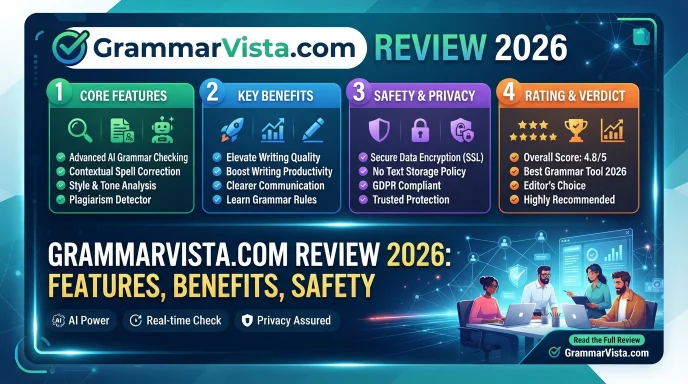
GrammarVista.com is a website that presents itself as a source of grammar, vocabulary, punctuation, and writing guidance. However, its current homepage also features articles about health, finance, home improvement, lifestyle, and other subjects. Anyone researching the website should understand what it actually publishes, how to evaluate its information, and whether it meets their needs.
One important distinction is the website address. GrammarVista.com and Grammervista.com are different domains. Their similar names can cause confusion, especially for people searching for an online grammar checker.
This guide explains what GrammarVista.com offers, how to assess its credibility, which alternatives are useful for learning English, and how to choose the right resource for your writing goals.
GrammarVista.com at a Glance
| Detail | What to know |
| Website | GrammarVista.com |
| Main stated focus | Grammar, vocabulary, punctuation, and writing guidance |
| Current content | A mix of language-related and general-interest articles |
| Intended audience | Readers seeking information, including people interested in English usage |
| Grammar-checking tool | Do not assume that the domain offers the same tools as similarly named websites |
| Best use | Explore relevant articles and independently verify important information |
| Important distinction | GrammarVista.com is not the same domain as Grammervista.com |
What Is GrammarVista.com?
GrammarVista.com is an online publishing website whose branding describes a focus on grammar and vocabulary. Its stated purpose includes helping readers understand language rules and improve their writing.
However, the website’s current homepage also displays articles in unrelated categories, including health, finance, home improvement, and lifestyle. This broader content mix matters because visitors searching specifically for grammar lessons may encounter material outside that subject.
The most accurate way to understand the website is to check its current homepage, navigation, article categories, and individual posts instead of relying on its name alone.
What Type of English Learning Content Does It Cover?
Grammar-related content associated with the Grammar Vista name includes topics such as:
- Grammar rules and sentence structure.
- Punctuation, apostrophes, and possessives.
- Compound words and spelling differences.
- Vocabulary, word meanings, and commonly confused terms.
- American English usage and writing clarity.
- Practical explanations of language mistakes.
The availability and organization of specific lessons can change. Check the current website before assuming that a particular topic, exercise, or feature is available.
Who May Benefit From Using GrammarVista.com?
The website may be useful to readers who find a relevant article addressing a language or general-information question.
Potential audiences include:
- Students looking for explanations of English usage.
- English language learners who want to understand unfamiliar words or sentence patterns.
- Professionals seeking reminders about grammar and clear communication.
- Writers and content creators researching word usage and writing conventions.
- General readers who want straightforward explanations of everyday questions.
Its usefulness depends on the subject, quality, and accuracy of the individual article. A website’s stated audience does not guarantee that every post will meet every reader’s needs.
GrammarVista.com Key Facts: Website Purpose, Content, and Limitations
The website’s branding emphasizes English-language learning, but its current content extends beyond grammar. That makes it important to evaluate each page individually.
Before relying on an article, check whether it:
- Answers the question clearly.
- Explains the rule or claim rather than simply stating a conclusion.
- Provides examples that support the explanation.
- Identifies an author or editorial team.
- Shows a publication or update date when relevant.
- Links to credible evidence for claims that need verification.
For time-sensitive or consequential topics, seek confirmation from a recognized authority rather than treating a general blog post as the final word.
Is GrammarVista.com a Grammar Checker or an Educational Website?
The distinction is important. A grammar-learning website typically explains rules through articles, definitions, and examples. A grammar checker accepts text and analyzes it for possible errors, depending on the tool’s features.
GrammarVista.com’s current public-facing content emphasizes publishing and informational articles. Do not assume that it provides an interactive text checker just because its name includes the word grammar.
If you want to paste a paragraph and receive automated corrections, verify that the exact domain offers that feature before entering your text.
What Is GrammarVista.com and How Does It Work?
The practical way to use GrammarVista.com is to visit the site, locate a relevant article, and evaluate whether its explanation answers your question. As with other publishing websites, navigation and content availability may change over time.
Grammar Lessons and English Language Resources
Grammar lessons explain how English words and sentences work. Useful lessons generally identify a rule, explain why it matters, and demonstrate the rule with correct and incorrect examples.
For example:
- Incorrect: She go to school every day.
- Correct: She goes to school every day.
The second sentence uses the verb form that agrees with the singular subject she in the simple present tense.
When reading a grammar guide, look for explanations of the underlying rule. Understanding why a sentence is correct makes it easier to apply the same principle in a new context.
Vocabulary, Spelling, and Word Usage Guides
Vocabulary guides help readers understand definitions, differences between similar words, and appropriate usage.
Consider advice and advise. Advice is a noun, while advise is a verb.
- My teacher gave me useful advice.
- I advise you to review the instructions.
A useful word guide should explain the difference and show how each word functions in a sentence. Definitions alone may not be enough to prevent repeated mistakes.
Sentence Structure and Punctuation Explanations
Sentence structure determines how ideas are organized. Punctuation helps readers understand the relationship between those ideas.
Compare these examples:
- Unclear: After the meeting ended we went home.
- Clearer: After the meeting ended, we went home.
The comma separates the introductory clause from the main clause. Some punctuation choices depend on sentence structure and style, so explanations should include context rather than presenting every convention as an absolute rule.
Articles About Commonly Confused Words and Phrases
Commonly confused words are a useful starting point for targeted learning. Examples include:
- Their, there, and they’re.
- Your and you’re.
- Affect and effect.
- Then and than.
- Its and it’s.
- Fewer and less.
The strongest explanations show the meaning and grammatical role of each word, then demonstrate how to choose the right form in a real sentence.
How to Navigate GrammarVista.com and Find Relevant Answers
Use a focused approach when searching the site:
- Visit the exact domain, grammarvista.com.
- Check the homepage and available navigation categories.
- Search for the specific grammar rule or word you need.
- Open the most relevant article.
- Read the examples and check whether they match your intended meaning.
- Verify the explanation with a reliable grammar reference when necessary.
If the site does not contain the answer, move to a more specialized resource rather than spending time browsing unrelated posts.
Does GrammarVista.com Offer Interactive Exercises, Quizzes, or Editing Tools?
Do not assume that interactive exercises, quizzes, or automated editing features are available without checking the current site.
An article with examples is different from a tool that evaluates a learner’s answers. Likewise, a grammar explanation is not the same as software that checks an entire document.
If you need interactive practice, look for a clearly functioning quiz or exercise. If you need automated corrections, test the specific checker using a short, non-sensitive sample before relying on its suggestions.
⭐ Is GrammarVista.com Legitimate, Safe, and Trustworthy?
A website’s legitimacy, safety, and editorial reliability are separate questions. A website may load securely but still publish inaccurate information. Similarly, a useful article does not prove that every other article on the same site is reliable.
GrammarVista.com has a public-facing website, but readers should evaluate individual pages and avoid assuming that the site’s name or branding guarantees accuracy.
How to Check the Website’s Ownership and Contact Information
Look for the website’s About, Contact, Privacy Policy, and Terms pages. These can help you understand who operates the publication, how to contact its team, and what policies apply to visitors.
Check whether the information is specific and consistent. A named author, editorial contact, or company description can help establish accountability, but it does not automatically verify the author’s expertise.
If you cannot establish who is responsible for a consequential claim, seek confirmation from an independent authoritative source.
How to Evaluate Article Accuracy and Editorial Quality
A reliable educational article should do more than repeat a definition. Look for a clear explanation, accurate examples, appropriate qualifications, and evidence for claims that require support.
Use this checklist:
- Does the article answer the question in its title?
- Are examples grammatically correct and relevant?
- Does the explanation distinguish rules from stylistic preferences?
- Are important exceptions acknowledged?
- Are factual claims supported by credible references?
- Is the information current enough for the subject?
For grammar questions, compare the article with established dictionaries, university writing resources, or recognized style guides.
Checking Author Credentials, Publication Dates, and Updates
Author information helps readers understand who created or reviewed a piece of content. A publication date can show when it first appeared, while an update date may indicate later revisions.
Neither date alone proves accuracy. Check whether the article reflects current conventions and whether its examples remain correct.
For specialized subjects such as law, finance, or health, also consider whether the writer has relevant expertise and whether the page cites appropriate primary sources.
How to Verify Grammar Rules With Authoritative References
For academic and professional writing, the Purdue Online Writing Lab (OWL) provides university-based explanations of grammar, sentence structure, spelling, and related writing topics.
You can compare a GrammarVista.com explanation with an established reference by following three steps:
- Identify the exact rule being discussed.
- Find a reference that covers the same rule and context.
- Compare the definitions and examples, paying attention to exceptions and regional differences.
If the explanations conflict, check whether one concerns formal academic writing while the other describes informal usage. Some differences reflect style or context rather than a simple right-or-wrong distinction.
Privacy, Cookies, Advertising, and Website Security Considerations
Before using any unfamiliar website, consider what information it collects and whether it asks you to submit personal data.
Check for HTTPS, review the privacy policy, and be cautious about unnecessary permissions or requests for sensitive information. HTTPS helps protect information in transit, but it does not guarantee that a website’s content or business practices are trustworthy.
If you are considering entering an essay, business document, or private message into an online tool, first verify how the tool processes and stores submitted text. Do not assume that a similarly named website follows the same privacy practices.
Warning Signs to Look for When Evaluating an Educational Website
Potential warning signs include:
- Unsupported claims presented as established facts.
- Examples that contradict the rule being explained.
- Missing or unclear information about authorship.
- Outdated material presented as current.
- Misleading claims about features or qualifications.
- Excessive promotional language without useful evidence.
One warning sign does not automatically prove that a site is fraudulent. It does mean you should investigate further and verify important information elsewhere.
⭐ GrammarVista.com vs. Grammervista.com: Understanding the Difference
The domains grammarvista.com and grammervista.com differ by one letter, but they should not be treated as interchangeable websites.
This distinction is especially important for searchers who want an automated grammar checker rather than a collection of informational articles.
Why the One-Letter Difference in the Domain Matters
Domain names identify separate web addresses. A small spelling difference can lead to a different operator, product, privacy policy, and set of features.
Before using a site, compare the address in your browser with the address you intended to visit. Do not rely only on the brand name displayed in a search result.
How to Confirm You Are Visiting the Intended Website
Use these checks:
- Read the full domain in the address bar.
- Check the homepage to understand the site’s stated purpose.
- Confirm the feature you want is actually available.
- Review the relevant About and Privacy pages.
- Avoid entering personal information until you understand the service.
If you followed a link from a third-party article, verify the destination before assuming it leads to the site described in that article.
Avoiding Misspelled Domains and Misleading Search Results
Search engines can return pages that discuss a website rather than pages operated by that website. A review, a tutorial, and the official homepage are different sources.
Open the exact domain and compare its visible features with the claims made in the review. This is especially useful when multiple sites have similar names.
⭐ GrammarVista.com vs. Grammarly: Website Content vs. Grammar-Checking Software
GrammarVista.com should not be confused with Grammarly, a separate writing-assistance product.
A content website may explain grammar rules, while writing-assistance software can analyze submitted text and suggest changes, depending on its features and settings.
| Need | Most suitable type of resource |
| Learn a grammar rule | Grammar guide or educational article |
| Understand a confusing word | Dictionary or vocabulary guide |
| Check a paragraph automatically | A verified grammar-checking tool |
| Improve academic writing | University writing resources and relevant style guides |
| Review a high-stakes document | Qualified editor or subject-matter professional, as appropriate |
A grammar checker can flag possible problems, but it cannot guarantee that a document is factually correct, logically sound, or appropriate for its intended audience.
What Does “GrammarVista.com USA” Mean?
The phrase “GrammarVista.com USA” may be used by searchers who want information about the website or American English conventions. The wording alone does not establish that a separate U.S.-only website or edition exists.
Is GrammarVista.com USA a Separate Website?
Do not infer a separate website from the words USA in a search query or article title. Start with the exact domain and inspect its current pages.
If another site claims to be an official American edition, check whether the original website links to it or explicitly identifies it as an authorized service. Without that confirmation, treat the relationship as unverified.
American English Content and Regional Language Conventions
American English has conventions that differ from those used in other English varieties. Differences may involve spelling, punctuation, vocabulary, and certain grammatical preferences.
For example, American English commonly uses color, while British English commonly uses colour. Both are correct within their respective conventions.
A useful language resource should identify which variety it follows when that distinction affects the answer.
American English vs. British English
Some differences are straightforward spelling variations, while others involve vocabulary, punctuation, and customary usage.
| American English | British English |
| color | colour |
| center | centre |
| organize | organise is common in some British styles |
| apartment | flat is common in everyday usage |
| vacation | holiday is common in everyday usage |
These are common patterns, not rules that apply to every writer or publication. British English also uses -ize in some established styles, so the spelling organize is not exclusively American.
American Spelling, Punctuation, and Usage Differences
American writing commonly places periods and commas inside closing quotation marks in standard prose, even when the punctuation is not part of the quoted material. Other English conventions may handle certain quotation marks differently.
Spelling can also vary in words ending in -or/-our and -er/-re. Vocabulary differences may influence how a sentence sounds to local readers.
The best approach is to follow the style guide expected by your school, employer, publisher, or audience.
⭐ How to Choose the Correct English Variant for Your Audience
Before editing a document, identify who will read it and which style they expect.
- U.S. audience: Follow the relevant American spelling and punctuation conventions.
- UK audience: Follow the British conventions requested by the publication or institution.
- International audience: Prefer clear, widely understood vocabulary and consistent spelling.
- Academic or business writing: Follow the assigned or organizational style guide.
Consistency matters more than mixing conventions without a reason.
Why English Grammar Matters in Everyday Communication
Grammar helps readers understand relationships between ideas, identify who is doing what, and interpret a message as intended. Correct grammar is valuable, but effective writing also depends on clarity, organization, tone, and accurate information.
Improving Clarity and Readability
Compare these sentences:
- Unclear: When Maria called her sister was driving.
- Clearer: When Maria called, her sister was driving.
The comma helps separate the introductory clause from the main clause. In some contexts, rewriting the sentence may make the intended meaning even clearer.
Good grammar supports readability by reducing ambiguity and helping readers follow a message without unnecessary effort.
Building Professional Credibility
A well-edited email, report, or application can help a writer communicate carefully and professionally. Frequent errors may distract readers from the message or make instructions harder to follow.
However, grammar alone does not establish professional competence. Accuracy, relevant knowledge, tone, organization, and judgment matter as well.
Preventing Misunderstandings
Small language differences can change a message’s meaning.
For example:
- Let’s eat, Grandma! addresses Grandma.
- Let’s eat Grandma! can suggest something very different without the comma.
The example is humorous, but it illustrates a real point: punctuation can influence how readers interpret a sentence.
Grammar Accuracy vs. Natural-Sounding English
A sentence can be grammatically correct yet sound awkward, overly formal, or unsuitable for its audience.
For example, I would like to make a request for your assistance is grammatical, but Could you help me? may be more natural in an everyday conversation.
Choose language based on context rather than assuming that the longest or most formal sentence is always best.
⭐ When Grammar Rules Allow More Than One Correct Form
English includes variation. Some forms differ by region, register, or style guide, and some sentences can be constructed correctly in more than one way.
For example, both The team is ready and The team are ready may occur in standard English, with preferences varying by dialect and whether the team is viewed as one unit or as individual members.
When you encounter different recommendations, investigate the context before deciding that one source must be wrong.
English Grammar Fundamentals for Beginners
Understanding a few core grammar concepts makes it easier to interpret explanations and correct everyday writing mistakes.
Parts of Speech
Parts of speech describe the roles words play in a sentence. A word’s role can sometimes change depending on how it is used.
Nouns and Pronouns
A noun names a person, place, thing, or idea. A pronoun can replace a noun or noun phrase.
- Noun: Jordan finished the assignment.
- Pronoun: He submitted it on time.
Pronouns should have clear references so readers know who or what they describe.
Verbs and Verb Tenses
Verbs express actions, states, or events. Tenses and related verb forms help communicate when something happens.
- Present: She writes every day.
- Past: She wrote yesterday.
- Future: She will write tomorrow.
Choose verb forms that match the intended time and maintain consistency unless the meaning requires a change.
Adjectives and Adverbs
Adjectives describe nouns and pronouns, while adverbs can modify verbs, adjectives, other adverbs, or entire clauses.
- Adjective: It was a careful decision.
- Adverb: She decided carefully.
Not every adverb ends in -ly, and not every word ending in -ly is an adverb.
Prepositions, Conjunctions, and Interjections
Prepositions express relationships, often involving time, place, or direction: under, before, and through.
Conjunctions connect words or clauses: and, but, and because.
Interjections express reactions or feelings, as in Wow! or Oh! Their use depends on the context and tone of the writing.
Subject-Verb Agreement
The verb should agree with its subject in person and number.
- Incorrect: The student write clearly.
- Correct: The student writes clearly.
A common source of mistakes is a phrase placed between the subject and verb.
– Correct: The box of old books is heavy.
The subject is box, not books. Identify the main subject before choosing the verb.
Articles: A, An, and The
English uses a, an, and the to indicate whether a noun is being introduced generally or identified specifically.
- A appears before a consonant sound: a university.
- An appears before a vowel sound: an hour.
- The refers to something identifiable in context: the book on the desk.
The choice between a and an depends on pronunciation, not simply the first written letter.
Singular and Plural Forms
Most countable English nouns form their plural with -s or -es, but irregular forms also exist.
- One book, two books.
- One class, two classes.
- One child, two children.
- One person, several people.
Some nouns have the same singular and plural form, while noncount nouns such as information generally do not take a regular plural in standard usage.
Possessives and Apostrophes
Apostrophes can show possession or form contractions.
- The student’s notebook refers to one student.
- The students’ notebooks refers to multiple students.
- They’re ready means they are ready.
Possessive pronouns such as hers, ours, and theirs do not take apostrophes.
⭐ Active Voice vs. Passive Voice
In active voice, the subject performs the action.
- Active: The editor revised the article.
- Passive: The article was revised by the editor.
Active voice often makes sentences more direct. Passive voice can be useful when the action matters more than the person performing it, or when the actor is unknown.
Choose the voice that best serves the sentence rather than treating passive voice as automatically incorrect.
⭐ Modals, Conditionals, and Common Verb Patterns
Modal verbs include can, could, may, might, must, should, and would. They can express ability, possibility, obligation, advice, or hypothetical situations.
- Ability: She can swim.
- Advice: You should check the details.
- Possibility: It might rain.
Conditionals describe possible or imagined situations: If you study, you will improve.
Learning common verb patterns also helps. For example, standard English generally uses enjoy reading, not enjoy to read, while both want to read and plan to read are standard constructions.
Sentence Structure and Punctuation Explained
Correct sentences require more than individual words in the right order. Writers must connect clauses logically and use punctuation to make relationships clear.
What Makes a Complete Sentence?
A complete sentence typically expresses a complete thought and contains an independent clause with a subject and a predicate.
- Fragment: Because the train was late.
- Complete sentence: Because the train was late, we arrived after noon.
The first example introduces a reason but leaves the reader waiting for the main idea.
Simple, Compound, Complex, and Compound-Complex Sentences
- Simple: The class ended.
- Compound: The class ended, and the students left.
- Complex: When the class ended, the students left.
- Compound-complex: When the class ended, the students left, and the teacher locked the room.
Varying sentence structure can improve rhythm and readability. Longer sentences should still make the relationship between ideas easy to follow.
Sentence Fragments and Run-On Sentences
A sentence fragment lacks a necessary component or fails to express a complete independent thought.
A run-on sentence improperly joins independent clauses. It may contain no punctuation or use punctuation incorrectly.
- Run-on: The lesson was useful I took notes.
- Correct: The lesson was useful, so I took notes.
- Also correct: The lesson was useful. I took notes.
A semicolon can also join closely related independent clauses: The lesson was useful; I took notes.
Commas and Introductory Phrases
Commas separate elements and clarify sentence structure.
Use commas appropriately in lists, after many introductory clauses or phrases, and between independent clauses joined by a coordinating conjunction.
- List: We bought pens, notebooks, and folders.
- Introductory clause: When the rain stopped, we went outside.
- Independent clauses: I finished the draft, and my editor reviewed it.
Comma rules can depend on sentence structure and style. Avoid adding a comma simply because a sentence feels long.
Semicolons, Colons, and Dashes
A semicolon can connect closely related independent clauses or separate complex list items.
A colon can introduce an explanation, example, or list after a complete introductory clause.
A dash can create emphasis or mark an interruption. Because dashes are visually strong, use them intentionally.
Apostrophes in Contractions and Possessives
Contractions combine words by omitting letters, as in don’t, can’t, and they’re. Possessive apostrophes indicate ownership, as in the teacher’s desk.
One of the most common distinctions is:
- It’s: contraction of it is or it has.
- Its: possessive form of it.
Example: It’s raining, and the dog is inside its kennel.
Quotation Marks and End Punctuation
Quotation marks identify quoted words and certain titles, depending on the style guide. Periods, commas, question marks, and other punctuation should reflect both the sentence structure and the quoted material.
American English commonly places commas and periods inside closing quotation marks in standard prose. Other punctuation may follow different rules depending on meaning and style.
When writing for school or publication, use the required style guide consistently.
⭐ How to Fix Ambiguous Sentences and Misplaced Modifiers
A misplaced modifier can make a sentence appear to describe the wrong person or thing.
- Ambiguous: She almost drove her children to school every day.
- Clearer, if the intended meaning is that she drove them nearly every day: She drove her children to school almost every day.
Place descriptive words close to the words they modify. After revising, ask whether a reader could reasonably interpret the sentence in an unintended way.
Vocabulary, Spelling, and Better Word Choice
Good vocabulary is not about choosing the most complicated word. It is about selecting a word that expresses the intended meaning accurately and naturally.
Using Context to Understand Word Meaning
A word may have several meanings depending on the sentence.
For example, draft can refer to an early version of a document, a current of air, or the selection of people for a particular purpose.
Read the surrounding sentence and paragraph before choosing a definition. If the meaning remains unclear, check a reputable dictionary such as Merriam-Webster.
Commonly Confused English Words
Their vs. There vs. They’re
- Their: shows possession. Their house is nearby.
- There: refers to a place or introduces a statement. The keys are there.
- They’re: means they are. They’re waiting outside.
Your vs. You’re
- Your: possessive determiner. Your answer is correct.
- You’re: contraction of you are. You’re ready to begin.
Affect vs. Effect
Affect is commonly a verb meaning to influence; effect is commonly a noun meaning a result.
- The weather can affect travel.
- The effect was noticeable.
There are less common uses of both words, so consider context in more advanced writing.
Then vs. Than
- Then: relates to time, sequence, or consequence. We ate, then we left.
- Than: makes a comparison. This route is shorter than the other one.
Advice vs. Advise
- Advice: noun. She gave me useful advice.
- Advise: verb. I advise you to read the instructions.
Compliment vs. Complement
- Compliment: praise. He gave her a compliment.
- Complement: something that completes or enhances another thing. The sauce complements the meal.
Fewer vs. Less
Fewer is traditionally used with countable plural nouns, while less is commonly used with uncountable quantities.
- Fewer mistakes.
- Less time.
Usage can vary with measurements and established expressions, so context matters.
Could Have vs. Could Of
Could have is the standard written form. Could’ve is its contraction and sounds similar to could of in ordinary speech.
- Incorrect in standard writing: I could of finished earlier.
- Correct: I could have finished earlier.
Compound Words: Closed, Open, and Hyphenated
Compound words combine two or more words into a unit.
- Closed: notebook, sunlight.
- Open: ice cream, living room.
- Hyphenated: well-known, mother-in-law.
Compound-word conventions can change over time and differ by dictionary or style guide. Check the specific expression rather than assuming every similar phrase follows the same pattern.
Common Spelling Errors and Frequently Misused Words
Frequent errors include confusing definitely with definately, separate with seperate, and receive with recieve.
To reduce spelling mistakes:
- Read the entire word rather than relying only on its sound.
- Learn recurring spelling patterns.
- Use a dictionary when uncertain.
- Review frequently misspelled words in your own writing.
- Proofread after making edits, since revisions can introduce new errors.
⭐ Connotation, Tone, and Choosing the Right Word for the Context
Words can have similar dictionary meanings but different emotional effects.
For example, slim often sounds positive or neutral, while skinny can sound critical depending on context. Likewise, inexpensive may sound more neutral or professional than cheap.
When choosing a word, consider its meaning, tone, audience, and setting. The most accurate word is the one that communicates your intended message without creating an unintended impression.
How to Use GrammarVista.com to Improve Your Writing
Reading a grammar article is only the first step. You gain more from it when you apply the explanation to your own writing and check whether the correction improves meaning.
Start With a Specific Grammar Question
Instead of searching for general advice such as “How do I write better?”, identify the problem you want to solve.
Examples include:
- When should I use a comma before and?
- What is the difference between its and it’s?
- How do I correct a sentence fragment?
- When should I use the past perfect tense?
Specific questions make it easier to find relevant explanations and test the rule in context.
Read the Explanation and Compare Examples
Do not stop after reading the corrected sentence. Identify what changed and why.
For example:
- Original: He don’t understand the question.
- Revised: He doesn’t understand the question.
The correction changes don’t to doesn’t because the subject he requires the third-person singular form in the simple present tense.
Understanding that pattern helps you correct similar sentences independently.
Apply the Rule to Your Own Sentences
After reading a lesson, create two or three examples using the same rule. Compare them with the explanation and check whether the sentence still communicates your intended meaning.
For instance, after studying subject-verb agreement, review sentences with she, they, the team, and phrases that separate the subject from the verb.
This practice is more useful than memorizing a rule without applying it.
Check Exceptions and Alternative Usage
English rules often have exceptions or context-dependent applications. A short article may simplify a concept for beginners, so verify the explanation when a sentence does not fit the stated pattern.
Check whether the issue involves formal or informal English, American or British usage, or a specific style guide.
⭐ A Step-by-Step Method for Fact-Checking a Grammar Article
Use this process when a rule seems unfamiliar or when the writing is important:
- Identify the exact claim.
- Find a recognized dictionary, university writing guide, or relevant style guide.
- Compare the definitions and examples.
- Check whether the rule applies to your particular sentence.
- Review exceptions and regional differences.
- Apply the correction only if it preserves the intended meaning.
For important academic or professional documents, do not depend on one general blog post as your only reference.
⭐ How to Turn Grammar Lessons Into Lasting Skills
Build a habit of correcting and reviewing your own writing.
Keep a short list of mistakes you make repeatedly. Each time you encounter one, record the incorrect form, the correction, and a brief explanation.
Review the list weekly and try writing new sentences without looking at the answers. This helps you recognize patterns and gradually rely less on external guidance.
GrammarVista.com for Students and Academic Writing
Students need writing that is clear, logically organized, grammatically accurate, and appropriate for the assignment. Grammar resources can help, but students must also understand the subject and follow their institution’s academic policies.
Improving Essays, Assignments, and Research Papers
Start by organizing your argument before focusing on individual grammar errors. A clear structure helps readers understand the purpose of each paragraph.
When revising an essay, check:
- Whether the introduction establishes the topic.
- Whether each paragraph supports the main argument.
- Whether examples and evidence support the claims.
- Whether transitions connect related ideas.
- Whether grammar and punctuation make the argument easy to follow.
Grammar correction cannot compensate for an unsupported argument or inaccurate evidence.
Writing Clear Thesis Statements and Topic Sentences
A thesis statement communicates the central argument or purpose of an essay. Topic sentences introduce the main point of individual paragraphs.
Weak: Education is an important topic with many things to discuss.
Clearer: Access to affordable education can improve career opportunities by reducing financial barriers and expanding students’ choices.
The second statement presents a more specific position that the essay can develop and support.
Maintaining Consistent Verb Tenses
Academic writing often requires consistent tense within a discussion, but the appropriate tense depends on the subject and discipline.
For example:
- The experiment showed a difference between the groups.
- The results suggest that the treatment may be effective.
The past tense describes the completed experiment, while the present tense interprets the findings. A tense change is appropriate when the meaning requires it.
Using Pronouns and Transitions Correctly
Pronouns should refer clearly to the nouns they replace.
Unclear: When Maya spoke to Sara, she seemed worried.
The reader cannot tell who seemed worried. Rewriting the sentence resolves the ambiguity: Maya seemed worried when she spoke to Sara.
Transitions such as however, therefore, for example, and in addition clarify relationships between ideas. Choose transitions based on the actual relationship rather than using them simply to make writing sound formal.
Formal Language, Academic Tone, and Word Choice
Academic writing generally favors precise language, careful claims, and a tone suitable for the subject. That does not mean every sentence must be long or complicated.
Prefer The results support the hypothesis over The results are really good and show that the idea is probably right when writing a formal research report.
Avoid unnecessary jargon, exaggerated claims, and vague expressions. Clarity is more valuable than complexity.
⭐ Grammar Help vs. Academic Integrity: Using Learning Resources Responsibly
Grammar resources can help students learn rules, identify errors, and improve clarity. However, students should follow their institution’s policies on editing assistance, proofreading, and AI tools.
Use explanations to understand your mistakes rather than automatically accepting every suggested change. Do not submit generated or rewritten work as your own if doing so violates course rules.
The goal is to improve your writing skills while preserving the accuracy, originality, and integrity of your work.
GrammarVista.com for Professional Communication
Professional writing should make the intended action, information, or decision easy to understand. Grammar accuracy helps, but tone and organization are equally important.
Writing Clear and Professional Emails
Creating Informative Subject Lines
A useful subject line tells the recipient what the message concerns.
Vague: Question
Clearer: Question About Friday’s Project Deadline
Specific subject lines make messages easier to identify and prioritize.
Explaining the Purpose Early
State the main reason for the email near the beginning.
For example: I’m writing to confirm the revised delivery date for the report.
This gives the reader context before the supporting details.
Making Requests Specific
Tell the recipient what you need and, when relevant, when you need it.
Vague: Please send the information soon.
Clearer: Could you send the updated figures by Thursday afternoon?
Specific requests reduce unnecessary follow-up messages.
Choosing a Suitable Professional Tone
Professional language should be respectful without sounding artificial.
Instead of I hereby request that you provide the aforementioned document, write Could you please send me the document?
The appropriate level of formality depends on the recipient, organization, and purpose of the message.
Improving Business Reports and Workplace Documents
Reports, proposals, and workplace instructions benefit from clear headings, consistent terminology, concise paragraphs, and accurate punctuation.
During editing, check whether each section has a clear purpose. Define technical terms when necessary, avoid unexplained abbreviations, and distinguish confirmed facts from estimates or recommendations.
For important business documents, a grammar review should be followed by a factual and contextual review.
Formal vs. Informal English
Different situations call for different levels of formality.
- Informal: Can you send me the file?
- Neutral professional: Could you send me the file when you have a chance?
- More formal: Would you please provide the file at your earliest convenience?
All three can be appropriate. Choose the version that fits the relationship and situation instead of assuming formal language is always better.
⭐ Editing Resumes, Cover Letters, and Professional Messages
Job applications require accurate, concise, and consistent writing.
Before submitting a resume or cover letter:
- Check spelling of names, job titles, and organizations.
- Use consistent verb tense for current and previous roles.
- Begin bullet points with clear action verbs where appropriate.
- Remove vague or repetitive statements.
- Verify dates, qualifications, and achievements.
- Check that the tone matches the position and employer.
A proofreading tool may help identify language errors, but it cannot verify whether your experience or qualifications are represented accurately.
GrammarVista.com for English Language Learners
English learners often need explanations that connect grammar rules with real communication. Short examples, repeated practice, and reading in context can help learners move from recognizing a rule to using it naturally.
Grammar Practice for Beginner, Intermediate, and Advanced Learners
Beginners may benefit from learning sentence order, basic verb forms, articles, and common vocabulary. Intermediate learners can focus on tense consistency, conditionals, relative clauses, and more complex sentences. Advanced learners may need help with nuance, register, idioms, and editing for a specific audience.
Choose resources that match your current level. Studying advanced grammar before mastering basic sentence patterns can make learning unnecessarily difficult.
Building Vocabulary Through Context and Examples
Learn new words in sentences rather than memorizing isolated definitions.
For each new word, record:
- Its meaning in the sentence.
- Its part of speech.
- Common words that appear with it.
- A natural example of your own.
- Any important differences from similar words.
This approach helps you understand not only what a word means but how people use it.
Learning Natural English Expressions and Collocations
A collocation is a combination of words that commonly appear together. For example, English speakers usually say make a decision, take a break, and strong coffee.
A sentence may be grammatically correct but still sound unnatural if it uses an uncommon combination of words. Reading well-edited English and paying attention to repeated expressions can improve naturalness.
Avoiding Common Errors Made by English Learners
Some recurring challenges include:
- Leaving out articles.
- Using incorrect verb forms.
- Mixing past and present tenses without a reason.
- Choosing a preposition that does not fit the expression.
- Translating phrases directly from another language.
- Confusing words with similar spellings or meanings.
Keep a personal list of recurring errors and practice each one in several new sentences.
⭐ Improving Grammar Without Losing Fluency or Confidence
Do not try to correct every minor error while speaking. Excessive self-monitoring can interrupt communication and make practice stressful.
Instead, focus on one or two recurring problems at a time. During writing practice, revise more carefully. During conversation practice, prioritize conveying your message and review common errors afterward.
Progress comes from repeated use, feedback, and gradual improvement rather than perfect grammar in every sentence.
⭐ When to Use a Teacher, Tutor, or Professional Editor
A self-study website can help with specific questions, but it cannot always identify why a learner repeatedly makes the same mistake.
Consider additional support when:
- You do not understand conflicting explanations.
- You need feedback on extended writing.
- You are preparing for a language examination.
- You need specialized academic or professional writing support.
- You want structured speaking and listening practice.
A teacher or tutor can adapt lessons to your needs, while an editor can help with a specific document. Choose support based on the problem you need to solve.
⭐ GrammarVista.com Pros and Cons
Whether GrammarVista.com is useful depends on what you expect from it. A relevant, accurate article can be helpful, but a general publishing website should not automatically be treated as a complete English-learning program.
Potential Benefits of Topic-Based Grammar Guides
Grammar-focused articles can be convenient when you need a quick explanation of a specific rule or word.
Potential benefits include:
- Learning at your own pace.
- Revisiting explanations when needed.
- Comparing examples of correct and incorrect usage.
- Finding answers to narrow language questions.
- Practicing independently without scheduling a lesson.
These benefits depend on the quality and relevance of the content available.
Limitations of Learning From Articles Alone
Articles may explain rules without offering personalized feedback or enough practice. They also cannot always identify the source of an individual learner’s mistakes.
Other limitations to consider include:
- A topic may not be covered in sufficient depth.
- Examples may not reflect every context or dialect.
- Some pages may lack clear authorship or references.
- A general-interest publication may include material unrelated to grammar.
- Reading explanations does not guarantee that a learner can apply the rules correctly.
Supplement articles with exercises, reading, writing, and feedback.
Missing Features to Check Before Relying on the Website
Before treating a site as your main learning resource, check whether it actually provides the features you need.
For example, does it offer structured lessons, practice questions, progress tracking, interactive quizzes, or automated text analysis? Do not assume that any of these features exist unless you can confirm them on the site itself.
If you need a complete course, personalized corrections, or exam preparation, a collection of articles may not be enough.
⭐ Is GrammarVista.com Enough for Independent English Learning?
It may help with individual questions, but relying on a single website is rarely the strongest approach to learning a language.
A balanced learning routine can include grammar explanations, dictionary use, reading, listening, writing practice, and feedback. Each activity develops different skills.
Use GrammarVista.com when its content answers a relevant question. Add other resources when you need structured practice or more authoritative guidance.
GrammarVista.com Alternatives: Other Ways to Learn and Check English
Different resources serve different purposes. A grammar guide may explain why a sentence is incorrect, while a dictionary clarifies word meaning and a proofreading tool identifies possible errors in a document.
Grammarly for Grammar and Writing Suggestions
Grammarly is a writing-assistance product that can help identify potential grammar, spelling, punctuation, and style issues, depending on the features available in the version you use.
It may suit writers who want suggestions while editing emails, documents, or other text. However, automated recommendations can be wrong or unsuitable for a particular context. Review each change rather than accepting every suggestion automatically.
Purdue OWL for Academic Writing Guidance
Purdue OWL is particularly useful for students and writers who need detailed explanations of grammar, punctuation, academic writing, and research-related conventions.
Its educational resources are suitable for checking specific rules and understanding writing principles. It is a reference resource rather than a substitute for a teacher’s feedback or an institution’s assignment requirements.
Cambridge Dictionary for Definitions and Usage
Cambridge Dictionary can help readers check definitions, pronunciation, grammatical information, and example sentences.
A dictionary is especially useful when a word has multiple meanings or when you are unsure how it functions in a sentence. Check the relevant definition and usage examples rather than relying on the first meaning displayed.
Merriam-Webster for American English and Word Meanings
Merriam-Webster is another useful reference for English definitions, spelling, word history, and usage information. It can be particularly helpful when checking American English vocabulary and commonly confused words.
Use dictionary entries to confirm meaning, but remember that a dictionary definition does not necessarily settle every question about tone, style, or sentence construction.
⭐ Which Grammar Resource Is Best for Your Specific Goal?
| Your goal | Resource type to prioritize |
| Understand a specific grammar rule | Educational grammar guide |
| Check the meaning of a word | Reputable dictionary |
| Receive automated writing suggestions | Grammar-checking software |
| Improve an academic essay | University writing resources and instructor feedback |
| Build English fluency | Structured lessons, reading, listening, and conversation |
| Edit a high-stakes document | Professional editor or qualified subject-matter reviewer |
The best resource is the one that addresses your actual need. You may benefit from combining two or more resources rather than expecting one website to do everything.
⭐ Grammar Learning Websites vs. Automated Proofreading Tools
Grammar learning websites explain language concepts, while automated proofreading tools analyze text and suggest changes. The two approaches complement each other.
For example, a checker might flag a subject-verb agreement error. A grammar guide can then explain why the correction is needed, helping you avoid the same mistake in future writing.
Neither method guarantees a perfect result. Always review corrections in context, especially when meaning, tone, or specialized terminology matters.
How to Make Any Sentence Clearer and More Accurate
You can improve many sentences by following a repeatable editing process. Start with meaning, then examine structure, wording, and mechanics.
Step 1: Identify the Main Message
Ask what the sentence needs to communicate. If you cannot summarize its purpose in a few words, it may contain too many ideas.
Original: Due to the fact that the meeting was delayed, we were unable to start the discussion at the time that had previously been planned.
Clearer: Because the meeting was delayed, we couldn’t start the discussion as planned.
The revision preserves the main message while removing unnecessary wording.
Step 2: Find the Subject and Main Verb
Identify who or what performs the action and which verb expresses it.
Incorrect: The list of requirements are available online.
Correct: The list of requirements is available online.
The subject is list, which is singular. The nearby plural noun requirements does not determine the verb form.
Step 3: Remove Unnecessary Words
Long phrases can often be shortened without losing meaning.
- At this point in time → Now
- Due to the fact that → Because
- In order to → To, when the shorter form preserves the intended meaning
Do not remove words simply to make a sentence shorter. Keep any detail that improves accuracy or helps the reader understand the message.
Step 4: Replace Vague or Repetitive Language
Words such as thing, stuff, and good can be vague when the context does not clarify their meaning.
Instead of The report contains some good information, write The report explains the project’s costs, timeline, and expected results if those are the details you mean.
Specific wording gives readers a clearer picture of the information.
Step 5: Check Grammar, Punctuation, and Word Choice
Review subject-verb agreement, verb tense, pronoun references, sentence fragments, and punctuation.
Then check whether each word expresses the intended meaning. A sentence can be grammatically correct yet contain an inaccurate or misleading word.
Step 6: Read the Sentence Aloud and Revise
Reading aloud can reveal awkward phrasing, repeated words, missing connections, and sentences that are difficult to follow.
If you run out of breath or lose track of the main point, consider splitting the sentence. However, long sentences are not automatically incorrect; clarity should guide the decision.
⭐ A Practical English Grammar Editing Checklist
Use this checklist before submitting an assignment, sending a professional email, or publishing an article.
Meaning and Clarity
- Does the writing communicate the intended message?
- Are the main points specific and easy to understand?
- Are pronouns clearly connected to their intended nouns?
- Are factual claims accurate and adequately supported?
Sentence Structure and Subject-Verb Agreement
- Does each sentence express a complete thought when required?
- Do subjects and verbs agree?
- Are independent clauses connected correctly?
- Are modifiers placed close to the words they describe?
Verb Tense and Pronoun Consistency
- Are verb tenses appropriate for the intended meaning?
- Are unnecessary tense changes removed?
- Are pronouns consistent and unambiguous?
- Are articles and prepositions used appropriately?
Punctuation, Capitalization, and Spelling
- Are commas and semicolons used correctly?
- Are apostrophes used properly in contractions and possessives?
- Are quotation marks and end punctuation consistent with the chosen style?
- Have spelling and capitalization errors been corrected?
Vocabulary, Tone, and Readability
- Are words accurate and appropriate for the audience?
- Is the tone suitable for the situation?
- Have unnecessary repetition and wordiness been removed?
- Is the language natural rather than needlessly complicated?
Final Proofreading Before Publishing or Submitting
- Have you reviewed the entire document after editing?
- Are names, dates, numbers, and links correct?
- Have you checked the document’s formatting?
- Have you verified important information using reliable references?
How to Improve English Grammar Over Time
Consistent practice is more effective than trying to memorize every rule at once. Focus on recurring mistakes, use English in meaningful contexts, and measure progress through your own writing.
Read Reliable English Content Regularly
Reading books, reputable articles, and well-edited publications exposes you to natural sentence patterns and vocabulary.
Pay attention to how writers connect ideas, introduce examples, and vary sentence structure. When you encounter an unfamiliar expression, record it and look up its meaning.
Keep a Personal Grammar Error Log
Maintain a list of errors you frequently make. For each entry, include the incorrect sentence, corrected version, and a short explanation.
For example:
- Incorrect: She don’t like coffee.
- Correct: She doesn’t like coffee.
- Rule: Use doesn’t with third-person singular subjects in the simple present tense.
Review your list regularly and write new examples to test your understanding.
Practice Rewriting Incorrect Sentences
Rewriting helps you apply rules rather than simply recognize them.
Take a sentence with a grammar error, correct it, and explain the change in your own words. Then create a similar sentence using different vocabulary.
This method builds transferable skills and makes it easier to notice the same pattern in future writing.
Learn Vocabulary in Phrases and Context
Learn phrases such as make progress, reach a conclusion, and pay attention instead of memorizing words in isolation.
Notice which words commonly appear together and whether a phrase is suitable for formal or informal communication. Contextual learning can improve both vocabulary and naturalness.
Use Grammar Quizzes and Writing Exercises
Quizzes can reveal which rules you understand and which need more practice. Choose exercises that provide explanations for incorrect answers.
After completing a quiz, write a few original examples using the rules you missed. This extra step helps convert test results into practical knowledge.
⭐ Build a Weekly Grammar Practice Routine
A simple routine can make learning manageable:
| Day | Practice |
| Monday | Study one grammar rule |
| Tuesday | Complete practice questions |
| Wednesday | Read an article and note useful expressions |
| Thursday | Rewrite sentences containing common mistakes |
| Friday | Edit a short paragraph of your own writing |
| Weekend | Review your error log and revisit difficult topics |
Adjust the schedule to your available time. Regular, focused practice matters more than following a rigid timetable.
⭐ Measure Progress Through Real Writing Samples
Save a short writing sample every few weeks. Compare it with an earlier sample and look for changes in clarity, sentence structure, grammar accuracy, and vocabulary.
You can also ask a teacher, tutor, or trusted editor to review recurring issues. Focus on improvements that make your writing easier to understand, not simply on producing longer or more complicated sentences.
Who Should Use GrammarVista.com?
GrammarVista.com may be relevant to readers who find useful information in its published articles. Its value depends on the subject being researched and the quality of the specific page.
Students and School Learners
Students may use relevant articles to clarify grammar concepts, review punctuation, or understand commonly confused words. They should still follow assignment instructions and verify important explanations.
College Students and Academic Writers
College students may need more detailed guidance on sentence structure, academic tone, and research writing. They can use relevant grammar articles as supplementary material alongside university writing resources and instructor feedback.
English Language Learners
Learners may benefit from clear definitions and practical examples when studying unfamiliar language patterns. To develop broader fluency, they should also practice reading, listening, speaking, and writing.
Professionals and Job Seekers
Professionals and job seekers can benefit from reviewing grammar, vocabulary, and communication conventions before preparing emails, reports, resumes, or cover letters.
For important applications and workplace documents, verify facts and review the content as well as the language.
Bloggers, Writers, and Content Creators
Writers may consult grammar resources when checking word usage, punctuation, spelling, and sentence clarity. They should also consider audience expectations, factual accuracy, originality, and editorial standards.
A grammar guide is one part of a broader content-quality process, not a substitute for research or editorial judgment.
⭐ Who May Need More Advanced Grammar Support?
Some users need more than a quick article. Consider structured instruction or professional feedback if you are preparing for an advanced English examination, writing a thesis, editing a complex report, or struggling with recurring errors despite regular practice.
A resource that works well for basic questions may not be sufficient for specialized writing needs.
⭐ How to Decide Whether GrammarVista.com Is Right for You
Before relying on the website, match its current content to the problem you want to solve.
Match the Website’s Content to Your Learning Goal
If you want an explanation of a specific word or grammar rule, look for an article that directly addresses it. If you need a structured course, interactive exercises, or automated corrections, verify that the site provides those features before depending on it.
Check Accuracy Before Applying Important Rules
Compare unfamiliar or disputed explanations with a reliable dictionary, university writing guide, or relevant style guide.
This is especially important when writing academic assignments, professional documents, or material that will be published publicly.
Consider Whether You Need Exercises or Personalized Feedback
Reading can help you understand a rule, but practice shows whether you can use it correctly. If the website does not provide suitable exercises or feedback, supplement it with another resource.
Choose the Right Resource for Casual Learning or Professional Editing
For casual learning, a clear article may be enough to answer a narrow question. For professional editing, you may need a dedicated checker, a style guide, or an experienced editor.
Choose based on the consequences of an error and the level of confidence you need.
Frequently Asked Questions About GrammarVista.com
What Is GrammarVista.com?
GrammarVista.com is a publishing website whose stated focus includes grammar, vocabulary, punctuation, and writing guidance. Its current homepage also features articles across broader informational categories.
Is GrammarVista.com a Grammar Checker Like Grammarly?
Do not assume it is. GrammarVista.com and Grammarly are separate services, and the availability of automated text checking must be confirmed on the exact website you intend to use.
Is GrammarVista.com USA a Separate Website?
The phrase “GrammarVista.com USA” does not by itself prove that a separate U.S. edition exists. Visit the exact domain and check its official pages before assuming another website is affiliated with it.
Is GrammarVista.com the Same as Grammervista.com?
No. The domains have different spellings and should be treated as separate websites. Always verify the address and the features offered before using a service.
Is GrammarVista.com Free to Use?
The cost and availability of any particular feature should be checked on the current website. Do not assume that every service associated with a similar name is free.
Is GrammarVista.com Safe and Trustworthy?
Evaluate its privacy policies, website security, author information, and the accuracy of individual articles. A secure connection alone does not establish that every claim on a site is reliable.
Can Beginners Use GrammarVista.com?
Beginners may find relevant grammar or vocabulary articles useful if the explanations are clear and appropriate for their level. They may need additional exercises and structured instruction to develop broader skills.
Can Students Use GrammarVista.com for Homework and Essays?
Students can consult relevant language explanations as supplementary learning material. They should verify important rules, follow their school’s academic-integrity policies, and ensure the final work reflects their own understanding.
Does GrammarVista.com Teach American English?
The website’s name and the phrase “GrammarVista.com USA” do not establish the scope of every article. Check the particular page for its spelling conventions, examples, and stated regional focus.
Can GrammarVista.com Help Improve Professional Writing?
A relevant, accurate article may help with a specific grammar or vocabulary question. Professional writing also requires clear organization, suitable tone, factual accuracy, and careful proofreading.
What Are the Limitations of GrammarVista.com?
Its current homepage includes content beyond English grammar, so readers may need to search carefully for relevant material. As with any publishing website, the accuracy, depth, and usefulness of an individual article should be evaluated separately.
What Is the Best Way to Improve English Grammar?
Study one rule at a time, practice with examples, read reliable English content, and review your own recurring mistakes. Consistent writing practice and feedback can help turn grammar knowledge into practical skill.
How Can I Check Whether a Grammar Rule Is Correct?
Compare the explanation with a reputable dictionary, university writing resource, or relevant style guide. Check whether regional conventions, sentence context, or exceptions explain any differences.
Should GrammarVista.com Replace a Teacher or Editor?
Not necessarily. Articles can answer focused questions, but a teacher can provide personalized instruction and an editor can review a document in context. Choose the level of support appropriate to your needs.
Which Websites Are Good Alternatives to GrammarVista.com?
Useful alternatives depend on your goal. Purdue OWL offers academic writing guidance, dictionaries help clarify word meanings, and dedicated writing-assistance tools provide automated suggestions. No single resource is ideal for every situation.
Final Verdict: Is GrammarVista.com Worth Exploring?
GrammarVista.com may be worth exploring when it contains an article relevant to your question. Its branding emphasizes grammar and vocabulary, but its current homepage also includes a broader mix of informational content, so it is important to check what the site actually offers rather than relying on its name.
The most important distinction is between learning resources and automated grammar-checking software. If you want to understand a rule, a well-written article or university reference can help. If you need automatic corrections, confirm that the exact service provides that functionality and review its privacy practices before submitting text.
Ultimately, use GrammarVista.com selectively, verify important claims, and supplement it with trusted dictionaries, educational references, and regular writing practice. The goal is not simply to correct individual sentences but to become a clearer, more confident, and more independent writer.

Ryan Flynn is a versatile content writer and blogger covering technology, business, health, fashion, lifestyle, home improvement, sports, and trending topics. With a passion for research and informative storytelling, he creates engaging, easy-to-understand articles that help readers stay informed, explore new ideas, and make smarter everyday decisions.